Rishikesh’s nearest airport is Jolly Grant, officially Dehradun Airport (DED). It is about 21 km out on the Dehradun to Rishikesh highway, roughly a 45-minute drive from town. The flight is the easy part. Almost every guide stops at “take a taxi, 21 km”, which is precisely where arriving starts to get complicated: you land, and you have to work out where to find a car, what the fare ought to be, and whether “Rishikesh” even means the place you are staying.
Ola and Uber cannot pick you up at the airport
This is the single most useful thing to know before you land. App cabs are not permitted to collect passengers at Jolly Grant. Pickups at the terminal are held by the local taxi operators, and the arrangement exists to protect their work. Dropping off at the airport is fine. Being picked up from it is not. So if you land, open the app and watch it fail to find anyone, nothing is broken and you are not doing it wrong. That is simply how the airport works.
Which leaves three real options: a taxi taken at the airport, a car arranged before you flew, or a walk out to the highway and public transport from there. They cost very different amounts, and with luggage the first two are the sensible ones.
What a taxi actually costs
There is no single official airport fare, and any page that hands you one number is guessing. It moves with the size of the car, with whether you booked ahead or walked up to the desk, with the hour you land, with the season, and above all with where exactly you are going.
In August 2026, published one-way rates for a small car to Rishikesh town sat roughly in the Rs. 900 to Rs. 1,500 band, a sedan or an SUV roughly Rs. 2,000 to Rs. 3,000. At the terminal itself, expect the top of those ranges or above, and a night surcharge of a few hundred rupees on a late arrival. Treat it as a reference point, not a price list.
Finding the cheapest number is not the point. Knowing it before you get into the car is. Whoever you book with, ask one question: is this the complete one-way price from Jolly Grant to my hotel, including airport charges? Then confirm where you are actually going, because that is where the arguments start.
Say the neighbourhood, not the city
This is the part every fare quote leaves out. To Rishikesh town (Triveni Ghat, the main market, the railway station), call it 21 km and about 45 minutes. To Tapovan, the neighbourhood that climbs above Laxman Jhula where a great many guests actually stay, it is a kilometre or two further on paper and another 15 to 20 minutes in practice. Your car stays on the same side of the river the whole way and climbs through Muni Ki Reti, and none of that last stretch is highway. It is town traffic and a slow finish, longer again in the evening or in season.
Every fare you have read online is a fare to Rishikesh town. Tapovan is another twenty minutes past it.
Say it out loud when you book, because a driver who agreed a price for “airport to Rishikesh” and then finds himself climbing to Tapovan has a fair argument for more money, and that argument happens at the end of your journey rather than the start. If you already know which stay you are heading to, give the driver the hotel name and the neighbourhood, not the city. Tapovan, say Tapovan. Swarg Ashram, say that. Further upriver, name the property.
One more question belongs to your hotel rather than your driver: can a car reach the entrance with luggage, and if not, where does it drop you? A room 300 metres off the road is nothing on a map and a different matter with two suitcases and a slope. That is why our guide to where to stay talks about road access, stairs and luggage rather than pins on a map.
And if you are going past the town, a rafting camp at Shivpuri, a retreat upriver, a village stay, do not book an airport to Rishikesh transfer and assume the last few kilometres come free. Confirm the whole destination and the whole fare before you travel.
The route, and how far it actually is
The drive runs Jolly Grant to Doiwala to Nepali Farm to Rishikesh, on the national highway the whole way. Nepali Farm, despite the name, is a highway junction rather than a farm, and it is where the road for Rishikesh leaves the Haridwar highway. The distance has never been the problem. What happens once you enter Rishikesh is.
The main road is about a kilometre away
The terminal sits roughly 1 to 1.5 km off the Dehradun to Rishikesh highway, down its own approach road, and walking out to that junction changes the price materially. Two things exist there that do not exist at the terminal: an app cab will accept a pickup from the main road, and the state buses running between Dehradun, Rishikesh and Haridwar stop at the Jauligrant crossing. A bus seat costs low hundreds of rupees rather than low thousands.
It is real local knowledge, and it is not for everybody. Worth doing if:
- You are travelling alone with one small bag
- You land in daylight
- You are happy to work things out as you go
- Your accommodation is easy to reach from the main road
A bad trade if:
- You have several bags, or children, or older parents with you
- It is raining hard, which in monsoon it will be
- You are landing after dark, or have something booked soon after you land
- You are carrying camera gear, which rules out most bloggers and content creators
App pricing on that road swings hard with demand too, worst at the early-morning arrival hours. The cheapest route is not always the easiest one.
Arriving after dark
Jolly Grant has had a night landing system since the modernisation that finished in 2008, so late arrivals are perfectly normal here. What stops working after dark is everything around them. The walk out to the highway is no longer sensible, the buses thin out, and your negotiating position at the taxi rank at 10pm is whatever the last driver decides it is.
That is the one arrival where an arranged pickup is the honest answer rather than an upsell. Someone already knows your flight number and where you are going, the fare was agreed while you were still at home, and nobody is doing arithmetic on a dark forecourt. You land, you collect your bags, you find your driver, you go. It is an add-on rather than something bundled into every trip, priced upfront the same way every transfer on How It Works is priced.
How much of the day to give it
Do not put anything in the diary for the hour you land. Between the plane, the bags, finding your driver and those last slow kilometres, a normal daytime arrival is comfortably 45 to 60 minutes of driving with the rest stacked either side. In the yatra months or on a long weekend, give yourself more.
How much that costs you depends on how long you have. On a single day in Rishikesh an afternoon landing takes most of the day with it, and there is a strong case for flying in the night before. Over two days an arrival morning is an easy half day, and over three you can lose the whole first afternoon to the road and never feel it.
If you are not flying
Two lines each, because this is orientation rather than the subject of the page. By train: Haridwar Junction, about 25 km away, is the practical railhead and much better connected than anything closer. Yog Nagari Rishikesh is nearer to town but has fewer and slower trains.
By road: Delhi is roughly 240 km, five to seven hours by car, with overnight buses arriving around sunrise. We do not reprint timetables or fares here, because they change faster than any page can. The live versions are at IRCTC for trains and RedBus for buses, and should be checked on the day you book rather than the day you read this.
What we actually do about it
Airport pickup and drop are add-ons, not a package inclusion, and your host quotes the figure before you agree to anything. The price you are told is the price you pay. Send us your flight number, when you land, the hotel or at least the neighbourhood, and how many of you there are with how many bags. We will tell you the sensible option and what it costs before you commit to anything.
What you are really buying is the thing this whole page is about: a car that is already there, that already knows whether you are going to town or to Tapovan, and a driver who has been paid the agreed amount rather than deciding it in the car park. If you are still choosing dates, the season you arrive in changes the drive too: the yatra months put a great deal more traffic on that same 21 km.
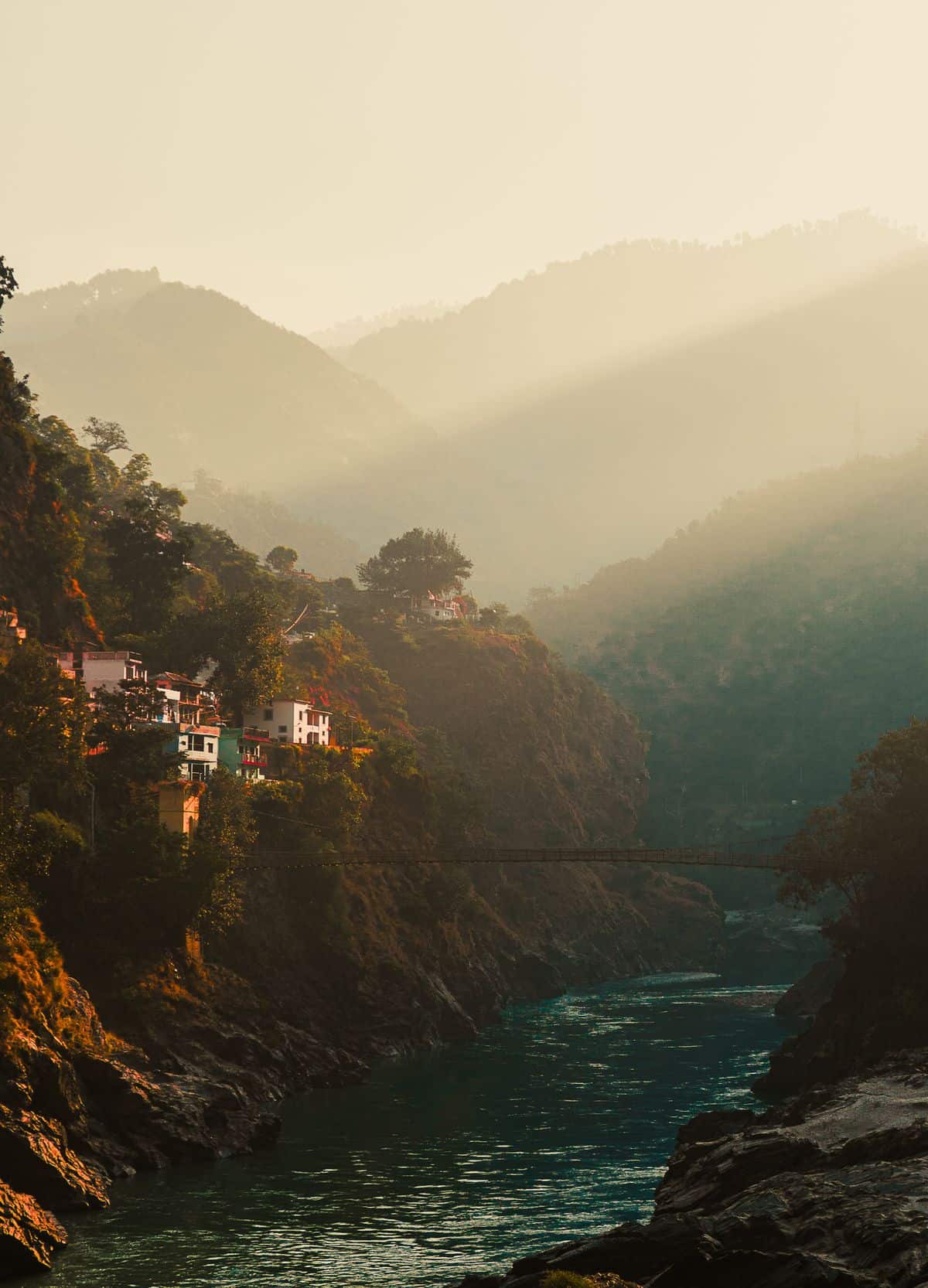
One last thing. Do not judge Rishikesh by the road in. The airport highway is practical and nothing more. Rishikesh starts feeling like Rishikesh when the hills close in, the Ganga appears and the traffic finally gives way to the river. The last 21 kilometres are only the transition. Make them easy, and the trip starts properly.