Only have one day in Rishikesh? You can still have a good one. The trick is not trying to see everything. Start early, choose one main morning activity, keep the afternoon on the riverside and ashram side, and finish with the aarti as the light goes. It is the same day we run for guests, written out so you can run it yourself. Nothing on this page needs booking through anybody.
The day at a glance
- 06:00 to 07:30 AM: Yoga, or simply sitting by the Ganga.
- 07:30 to 08:00 AM: A walk along the river, and a dip if conditions allow.
- 08:00 to 09:00 AM: Breakfast, properly.
- 10:00 AM to 01:00 PM: Rafting, or a waterfall. Not both.
- 01:00 to 02:00 PM: Lunch, then cross to the Swarg Ashram side.
- 02:30 to 03:30 PM: The Beatles Ashram.
- 03:30 to 04:30 PM: Bhootnath Temple, and the view from it.
- 04:30 to 05:30 PM: The riverside lanes, walking down.
- Sunset: Ganga aarti at Parmarth Niketan, and stay sitting afterwards.
Those times move with weather, traffic, river conditions and the season’s sunset. It is the shape of the day, not a train timetable, and a day in Rishikesh that runs half an hour behind is a day going well.
First, check what your date allows
Rafting runs in the open season, which Uttarakhand Tourism gives as roughly September to June, and pauses through the monsoon because the river is not safe to run. Dates still move with river conditions, so ask on the day. The waterfalls are the swap, and not a consolation prize: they run on rainfall rather than snowmelt, so they are at their best through the monsoon and the weeks after it. In August the mid-morning slot below is a waterfall. In October it can be either. For the month-by-month version, we wrote what each season in Rishikesh is actually good for.
06:00 AM: start by the Ganga
Do not start your only day in Rishikesh at nine. Get outside while the town is quiet and give the first hour to yoga, breathwork, meditation, or sitting by the water. It does not need to be a formal class. The point is to meet Rishikesh before the roads and the cafés fill up.
If you are staying around Tapovan or Laxman Jhula, the ghats nearby are the easy place to start. Sai Ghat is a short walk downstream and is where we hold our own morning practice: steps down to the river, pale sand where the water pulls back, wooded foothills opposite. There is a statue of Gangamata facing the water. Sit near it if you like, and if a small ritual is under way, wait rather than walking through it.
07:30 AM: the walk, and the dip
Give the river another twenty or thirty minutes on foot. Laxman Jhula at this hour belongs to the water: mist, temple bells, almost nobody else. If you want the holy dip, pick a suitable ghat and follow what the locals around you are doing. Bring a change of clothes and one layer more than you think, because the river throws cold air even in warm months. No soap, no shampoo, nothing plastic left on the sand. And if the water is rough or the steps are slippery, skip it. There is no prize for forcing an experience into an itinerary.
08:00 AM: breakfast, properly
This is not the morning for a small coffee and a piece of toast. The next block runs for hours. Eat near where you are staying rather than crossing town for it, and aim to be leaving by around half nine. The lanes by Laxman Jhula hold most of the cafés worth your time, and they are all in our guide to the cafés locals actually love.
10:00 AM: the rapids, or the waterfall
This is the most important decision of the day and it takes three hours either way. Make it the night before, because deciding at ten costs you the slot.
Rafting. The Rishikesh stretch runs mostly Grade II to Grade IV depending on where you put in. Shorter runs from Shivpuri or Brahmpuri stay in the gentler range; the longer ones start upstream around Kaudiyala or Marine Drive and cover the technical water first. Choose by your own comfort rather than by which is longest, and use an authorised operator. Our guide to the grades is the honest version of which stretch suits which person.
The waterfall. If rafting is not running, or you would rather walk through forest than sit in a raft, this is your morning. The one everybody means by “secret waterfall” is not the first fall you reach. You cross that one, climb past the upper fall, and keep going: the quiet third fall is the one worth the morning. If you would rather have a named walk you can plan around, Patna Waterfall on the Neelkanth road is the other. Grippy shoes, not sandals. In wet months wear long socks: there are leeches on the damp forest paths.
Three hours on the river or three hours in the forest. Not both. The afternoon is where the rest of Rishikesh fits.
01:00 PM: lunch, then cross the river
Come back into town and sit down properly. You have been awake since six. Eat, drink water, take the hour.
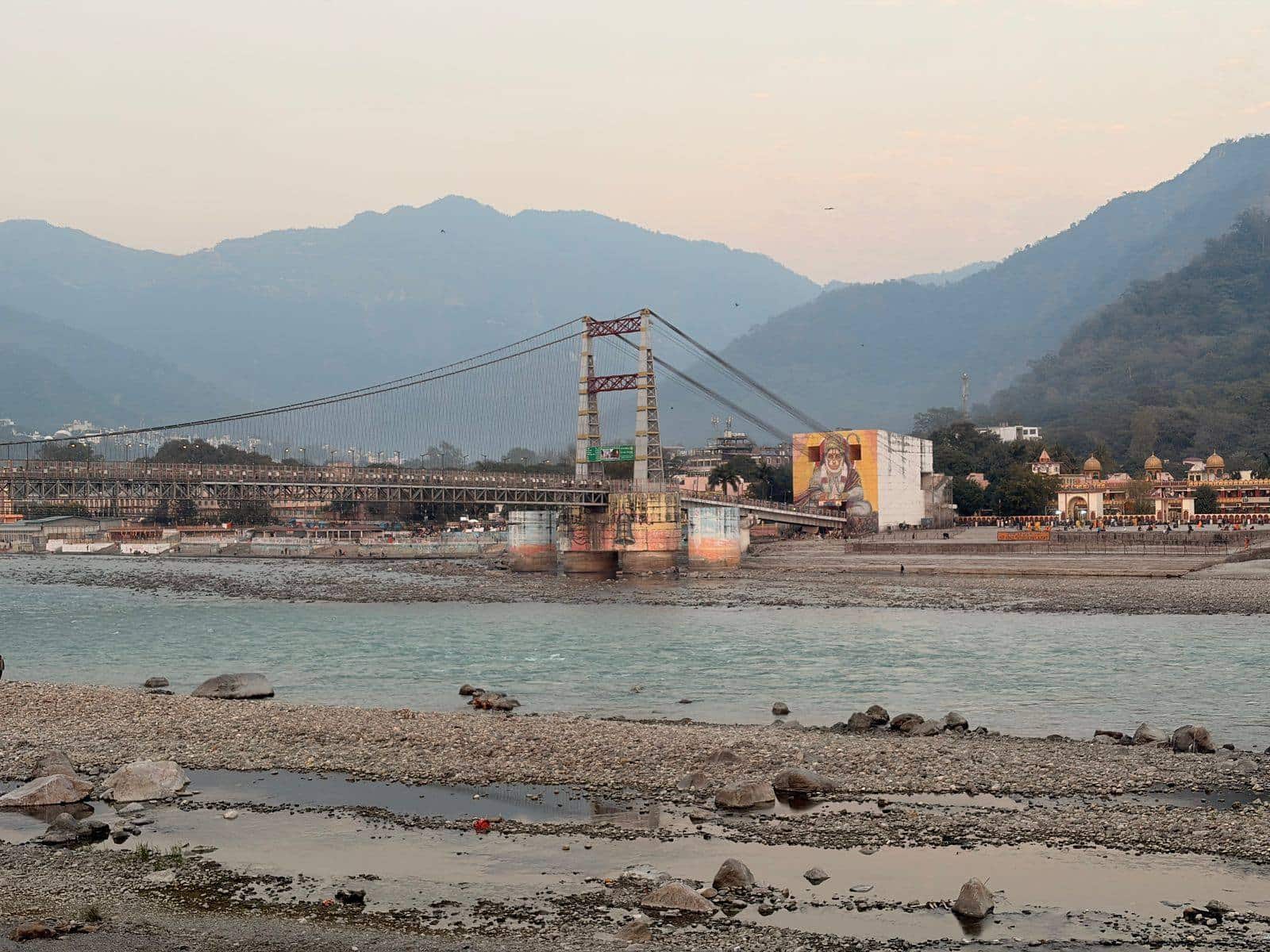
Then cross to the Swarg Ashram side over Ram Jhula. It is open, and it is walking only: no scooter, no motorbike, nothing on wheels. Laxman Jhula is the same. So if you are on two wheels, you walk across and your scooter goes round by Janki Setu, which is the bridge built to take them and is also the quietest of the three on foot. The pace drops the moment you are across, and everything from here until the evening is on foot, in one unhurried loop. That is why this day works at all in twenty-four hours.
02:30 PM: the Beatles Ashram
Keep going past Parmarth Niketan, out where the lanes thin and the road climbs into forest. Behind a gate up there is Chaurasi Kutia, which half of Rishikesh calls the Beatles Ashram. Maharishi Mahesh Yogi built it as a meditation ashram, the name means eighty-four huts, and the band came in 1968 to study Transcendental Meditation. The abandoned huts, the forest paths and the painted walls make it one of the most distinctive places in Rishikesh. Give it an hour, in closed shoes with grip, because the floors are uneven and the steps up the domes are shallow and worn.
There is a ticket, collected at the forest gate: Rs. 200 for Indian visitors and Rs. 1,000 for international visitors, with cheaper rates for students and senior citizens. Plenty of guides still quote the old Rs. 150 and Rs. 600. This is forest department pricing, it has changed before and will change again, so check on the day and carry cash. It also closes well before dark, which is one more reason it sits here rather than at five.
03:30 PM: the climb up Bhootnath
Back down towards the bridge, then up. Bhootnath Temple is a storeyed Shiva shrine above the Swarg Ashram side that most visitors walk straight past, because they are looking at the river rather than up. It is short but genuinely uphill, so budget fifteen to twenty minutes each way, with water. Each floor opens onto a wider view, until the top looks out over the whole river bend: the bridges, the ghats, the hills folding away behind them. Late afternoon light is far kinder than midday.
It is a working shrine rather than a viewpoint with a temple on it, so cover your shoulders and your legs before you climb. Traditionally you also bathe before visiting a temple. In Indian homes that is ordinary rather than formal, less about being clean than about arriving fresh. On this day you will have come straight off the river or a forest trail, so the version that fits is a rinse and a change of clothes at lunch. Nobody checks. But if you are wondering how to show respect in a place whose customs are not yours, this is the thing that quietly counts.
04:30 PM: the lanes, walking down
Come off the hill with an hour in hand and do not get straight into an auto. Walk. Move slowly through the riverside lanes and the ashram stretch, looking at what you would never notice from a vehicle: rudraksha malas, incense, spiritual books, chai in small glasses, people coming back up from the water. This is the part of Rishikesh that does not fit into a list of places to visit, which is exactly why you should leave time for it. It also puts you at the ghat unhurried before the steps fill.
Sunset: the aarti at Parmarth
You will notice the crowd has a direction. Everyone is walking towards the ghat at Parmarth Niketan, where the largest Ganga aarti in Rishikesh happens every evening as the light goes. It starts around sunset, so the hour shifts through the year. Check the day’s timing locally rather than trusting a number you read online, including this one.
Boys from the ashram sit in rows on the steps and sing. A fire is lit at the centre, lamps are circled towards the water, and people float small leaf boats with a flame in them that drift downstream in a thin line of light. Arrive before it starts, find a place to sit, and then stay. You do not need to photograph every minute. Take your picture of the seated Shiva statue out in the river early, in daylight, before you sit down.
Where you sit is a real choice. Low and central puts you inside it. Higher up you lose the detail but see the shape of the whole thing, and you can leave without climbing over anybody. Cover shoulders and knees, wear shoes you can slip off easily, bring a layer because the stone cools fast, and agree a meeting point with whoever you came with. There is a smaller version of the same thing at Sai Ghat, with fewer lamps and nobody directing where you stand, and if you only have one evening our guide to morning versus evening aarti is the one to read first. The short version: the evening one is the story you tell when you get home.
After the aarti, do not rush back
Everyone stands at once, everyone collects their shoes at once, and the lanes thicken for a while. So sit on for another ten minutes and let the steps empty around you. The ghat after the aarti is quieter than at almost any other hour. Then eat, and ask whoever serves you which café has live music tonight, because it changes night to night. This is usually the moment people understand why we do not fill every minute of a one-day trip. The quiet part at the end is often the part they remember.
What not to try to add
One day is not enough for everything, and being honest about that is more useful than padding the list. Leave these for another trip.
- Kunjapuri sunrise: A hilltop Shakti temple at roughly 1,676 metres, an hour’s drive out, leaving around 4:30 AM. Beautiful, but it replaces the morning above rather than joining it. If Kunjapuri is your priority, build the day around it instead of stacking it on top.
- Neelkanth Mahadev: Roughly 32 kilometres out, an hour to ninety minutes each way through forest. Half a day gone, so it belongs to a second day.
- Rafting and the waterfall: Pick one. Attempting both is how people end up missing the aarti, which is the part of this day nobody regrets.
- Every bridge and every ghat: You do not need to cross all three bridges because they are on a map. Use the crossing that suits your route and spend the time you save sitting still.
What to carry
- Water, sunscreen and sunglasses
- Walking shoes with grip, and something you can slip off at the ghat
- One change of clothes if you are rafting or taking a dip
- A light layer for the evening, because the ghat stone cools fast
- Cash, for the forest gate, chai, prasad and the market
- Clothes that cover shoulders and legs for the temple and the aarti
- Your phone in a secure pocket, and a small torch for the walk back
Getting here, and getting around
Getting to town is its own question, and the road in from Jolly Grant airport covers it. Once you are here, this day is almost entirely walkable. The morning is the exception: rafting starts with a drive upstream, and the waterfall is easiest on two wheels. Agree any fare before you get in.
Is one day enough?
Enough to see Rishikesh? No. Enough to experience it? Yes. In one day you get a sunrise morning, time beside the Ganga, one adventure or one forest walk, the Beatles Ashram, a hilltop temple, the lanes and an evening aarti. You just do not get all of Rishikesh, and that is fine. The goal of one day is not to finish the town. It is to leave feeling you actually met it.
If you have longer, slow this day down rather than adding attractions to it. That is what two days buys you, and three days lets you keep a whole morning empty and still see more. If you are still choosing how long to stay, how many days Rishikesh actually needs answers that one question. Here, the hour you leave empty is often the hour you remember most.
Or have the day run for you
Everything above is free and none of it needs us. If you would rather not hold the timings, the tickets and the taxi in your head on your only day here, that exact day is what our First Hello is. The same hours, with a guide (host) beside you.