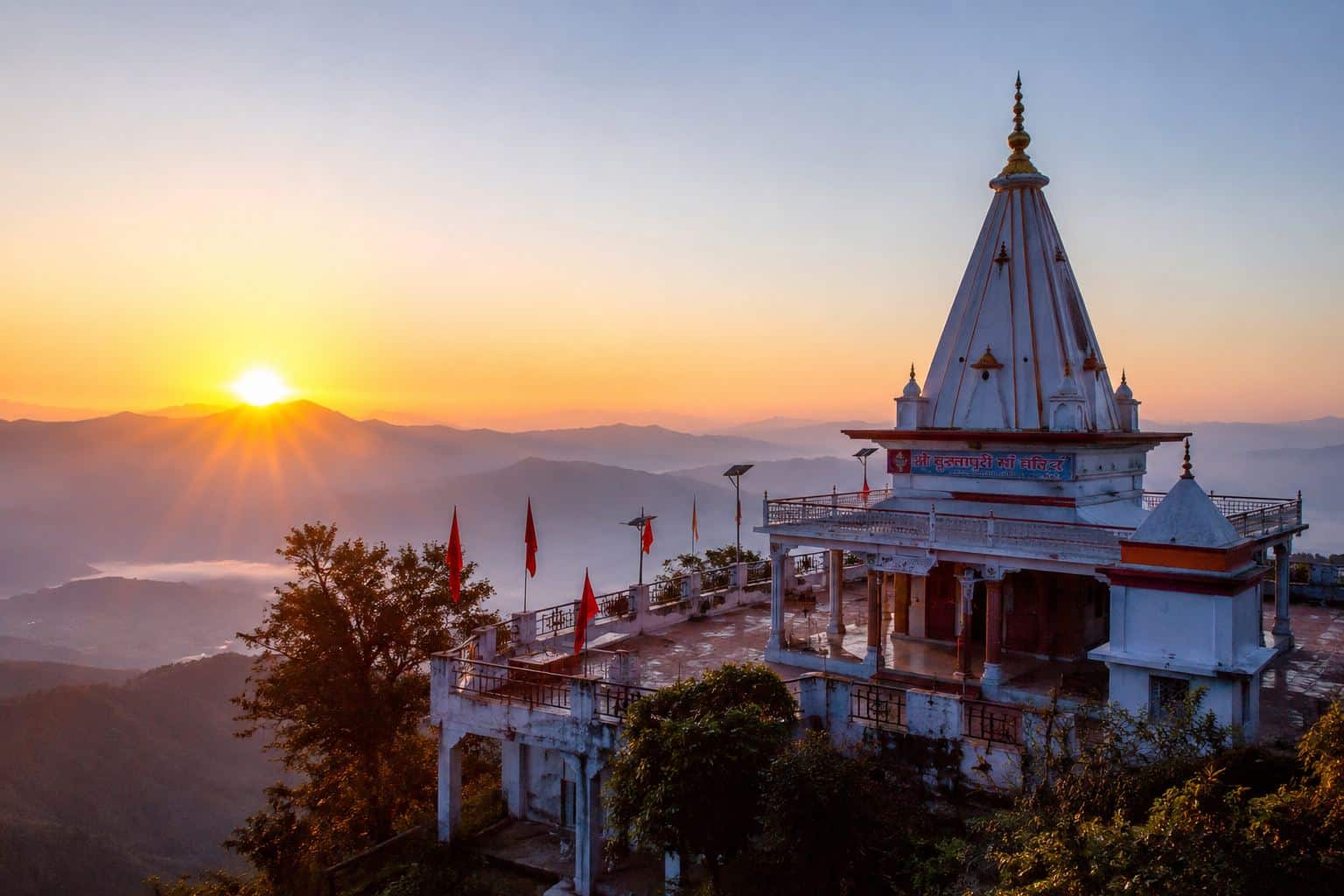
Every second traveller asks about it once they see the photograph. A small temple on a ridge. Mountains stretching behind it. The first light turning everything gold. That’s Kunjapuri, and yes, the sunrise really can look like that. But getting there means leaving Rishikesh before most people have thought about breakfast, so it helps to know exactly what you are signing up for.
What Kunjapuri actually is
Kunjapuri is a hilltop temple dedicated to Goddess Durga, sitting at about 1,676 metres above sea level in Tehri Garhwal. It is a religious site first and a sunrise viewpoint second.
The Tehri Garhwal district administration describes Kunjapuri as one of the Shakti Peethas in the Shivalik range, and highlights its panoramic views towards the Garhwal Himalayas, including Swargarohini, Gangotri, Banderpunch and Chaukhamba. That combination is what makes the place special: the temple, the mountain setting and, if the weather cooperates, a very good sunrise.
The 4 AM problem
The hardest part of Kunjapuri is not the climb. It is leaving Rishikesh while everyone else is asleep.
Your departure time depends on the season, because sunrise shifts considerably through the year. Many travellers leave around 4:00 to 4:30 AM, but do not treat that as a universal rule. Work backwards from the actual sunrise for your date, and give yourself some buffer. You are travelling into the hills before daylight, so a journey that looks short on a map can take longer than expected. From Rishikesh, allow roughly 45 minutes to an hour or more depending on where you start and the road.
The drive is part of it
The road climbs away from Rishikesh and the landscape changes quickly. The city disappears. The road winds through the hills. Then you are out in the darkness with only the headlights, the occasional village light, and the sky slowly beginning to change.
This is one reason Kunjapuri is better as a sunrise trip than a midday visit. The journey makes the arrival feel different.
The final climb
Once you reach the road-access point near the temple, there is a staircase up to the temple area. It is not a serious mountain trek for most reasonably fit travellers, but do not confuse “short” with “nothing”. You are climbing before sunrise. It may be cold. It may be dark. And your legs may still be thinking about the alarm clock. Wear shoes with decent grip, and use a torch or phone light for the darker sections. A warm layer is worth carrying even if Rishikesh feels warm when you leave.
Sunrise and darshan are two different things
This trips people up, and it is simpler than it sounds. There is no gate on the hill. You can climb up at 4 AM, at 5 AM, whenever you like, and watch the sunrise. Nobody stops you and nothing is closed.
What opens at a set time is darshan: standing before the Devi in the shrine itself. That is usually from around 6:00 AM. So the natural order of the morning is to arrive in the dark, watch the light come up over the ranges, and then take darshan once the shrine opens. You are not choosing between the two. You get both, in that order, and the wait between them is short.
The alarm is the unpleasant part. Everything after that is why you went.
What the sunrise actually looks like
On a clear morning, the first light appears over the distant ranges while the valleys below are still dark. That transition is the best part.
Do not expect the exact photograph you saw online every time. Cloud, haze and visibility can change the view completely. Some mornings give you a dramatic Himalayan panorama. Some give you layers of green hills and a softer sunrise. And some mornings are simply cloudy. That is mountain weather. Think of Kunjapuri as a high, open Himalayan viewpoint rather than a guaranteed snow-peak photograph.
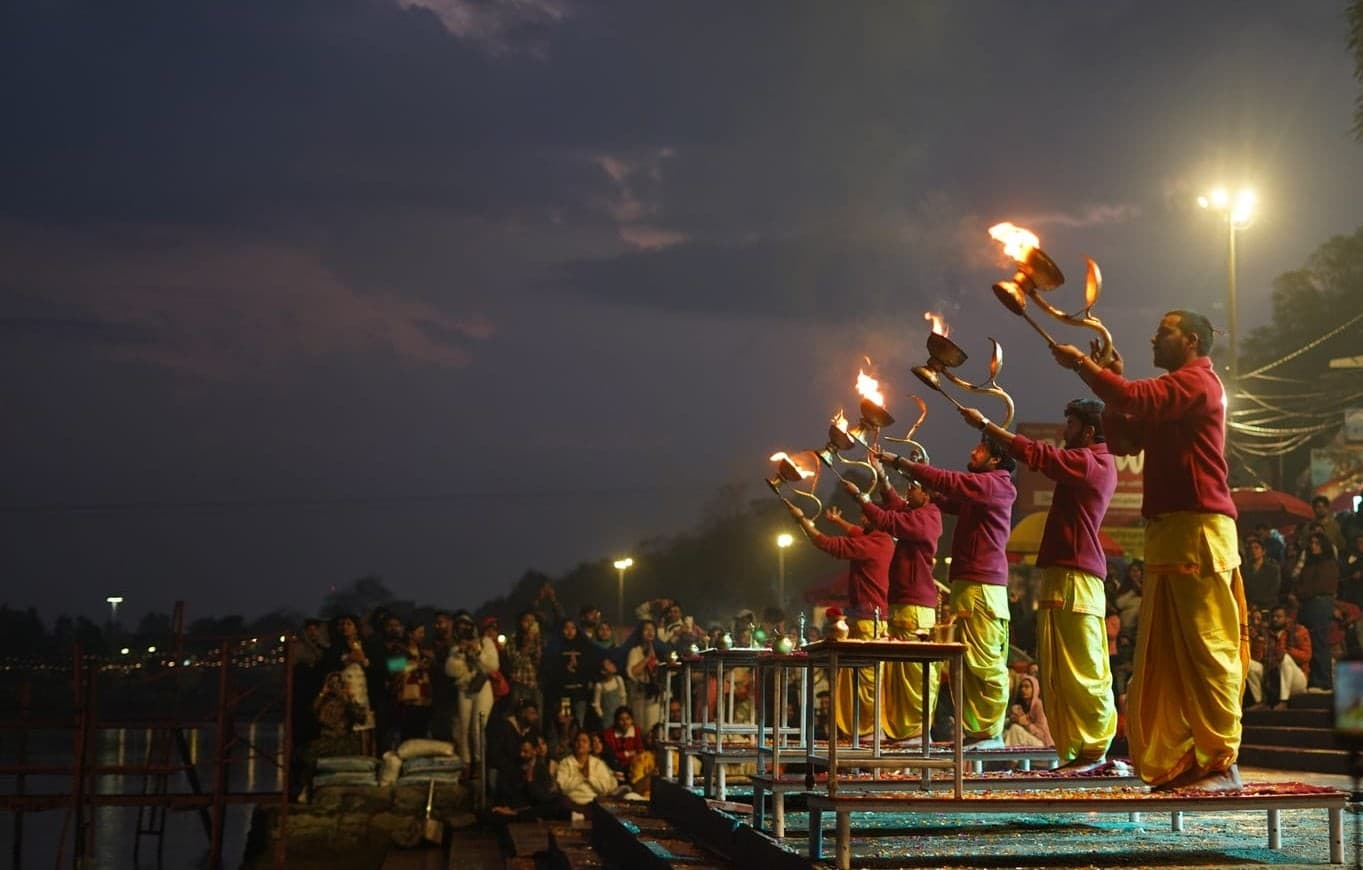
You are also back in town early, which puts the quieter morning aarti within reach before breakfast, a low-key addition on the way back rather than a second early start.
When is the best time to go?
The district administration treats Kunjapuri as a year-round destination, and mentions both sunrise and sunset. For the clearest Himalayan views, post-monsoon and winter mornings are often a good bet. But do not turn that into a guarantee. A clear summer morning can be spectacular, and a cloudy winter morning can hide everything. Weather matters more than the calendar. If the forecast shows heavy cloud or rain, lower your expectations for the panorama.
The proper Kunjapuri trek
There are two ways to experience Kunjapuri. The first is the standard sunrise visit: drive most of the way up and walk the final stairs. The second is a proper hike. The district administration identifies a roughly 5 km forest route from Hindolakhal village to the temple, which is a completely different experience.
If your main goal is sunrise, the road-access option makes sense. If your main goal is hiking, give yourself enough time to enjoy the trail rather than squeezing a full trek into a rushed sunrise schedule. Do not confuse the two when booking a trip.
What should you take?
You do not need a big trekking bag. For the normal sunrise visit, this is enough:
- A warm layer
- Water
- Shoes with good grip
- A torch or a charged phone
- A small snack
- Some cash
- Respectful clothing for the temple
Who should go, and who can skip it
Go if you are willing to sacrifice a little sleep for a mountain morning. It suits:
- First-time visitors to Rishikesh
- Couples
- Photographers, bloggers and content creators
- Yoga and wellness travellers
- Spiritual seekers, and anyone who would rather start a day at a shrine than a cafe
- Anyone who wants to see the whole Rishikesh valley laid out below them
And you can skip Kunjapuri without feeling you have somehow failed your Rishikesh trip. It costs you a morning, not a day: you are back in town for breakfast either way. How much that morning is worth depends on how long you have. On a single day in Rishikesh it is a real trade, and there is a good case for staying by the river instead. Over two days it fits comfortably, and over three you can simply pick the clearest morning of the three and go then.
One thing to remember
Kunjapuri is a temple. People come here to pray, make offerings and stand before the Devi. So even if you are there mainly for the sunrise, behave like a visitor to a place of worship rather than someone arriving at a viewpoint. Keep the noise down, follow local instructions, and ask before photographing people who are praying.
Wear clothes that cover you properly. Shoulders and legs covered is the simple version. It costs you nothing and it means you walk in as a guest rather than as a tourist.
And if you can, shower before you go. In Indian homes this is ordinary rather than formal: you bathe before you visit a temple. It is less about being clean than about arriving fresh, having set the day aside for it. Nobody will check, and nobody will mind if you have travelled a long way. But if you are wondering how to show respect in a place whose customs are not yours, this is the thing that quietly counts.
How this fits into a trip with us
Kunjapuri is the signature sunrise of Live Like a Local’s big middle day, and a fixture of our wellness retreats. Your guide (host) handles the early pickup, the drive, and the timing, so you are at the top with minutes to spare rather than sprinting the last flight of steps. They will also tell you honestly, the evening before, whether the forecast is worth the alarm.
Frequently asked questions
What time should I leave Rishikesh for the Kunjapuri sunrise?
Many travellers leave around 4:00 to 4:30 AM, but work backwards from the actual sunrise for your date and give yourself buffer, since sunrise shifts considerably through the year. From Rishikesh, allow roughly 45 minutes to an hour or more depending on where you start and the road.
Is Kunjapuri Temple open early enough for sunrise?
Yes. There is no gate on the hill, so you can climb up whenever you like and watch the sunrise, with nothing closed and nobody stopping you. Darshan, standing before the Devi in the shrine, usually opens from around 6:00 AM, so you watch the light come up first and take darshan once the shrine opens.
What will the sunrise at Kunjapuri look like?
On a clear morning the first light appears over the distant ranges while the valleys below are still dark, which is the best part. But cloud, haze and visibility change the view, so some mornings give a dramatic Himalayan panorama, some give softer layers of green hills, and some are simply cloudy.
What should I bring to Kunjapuri?
For the normal sunrise visit you do not need a big trekking bag: a warm layer, water, shoes with good grip, a torch or charged phone, a small snack, some cash, and respectful clothing for the temple. There is a staircase up to the temple area, so shoes with decent grip matter.
What is the best time of year to visit Kunjapuri?
The district administration treats it as a year-round destination, and for the clearest Himalayan views post-monsoon and winter mornings are often a good bet. Weather matters more than the calendar, so if the forecast shows heavy cloud or rain, lower your expectations for the panorama.