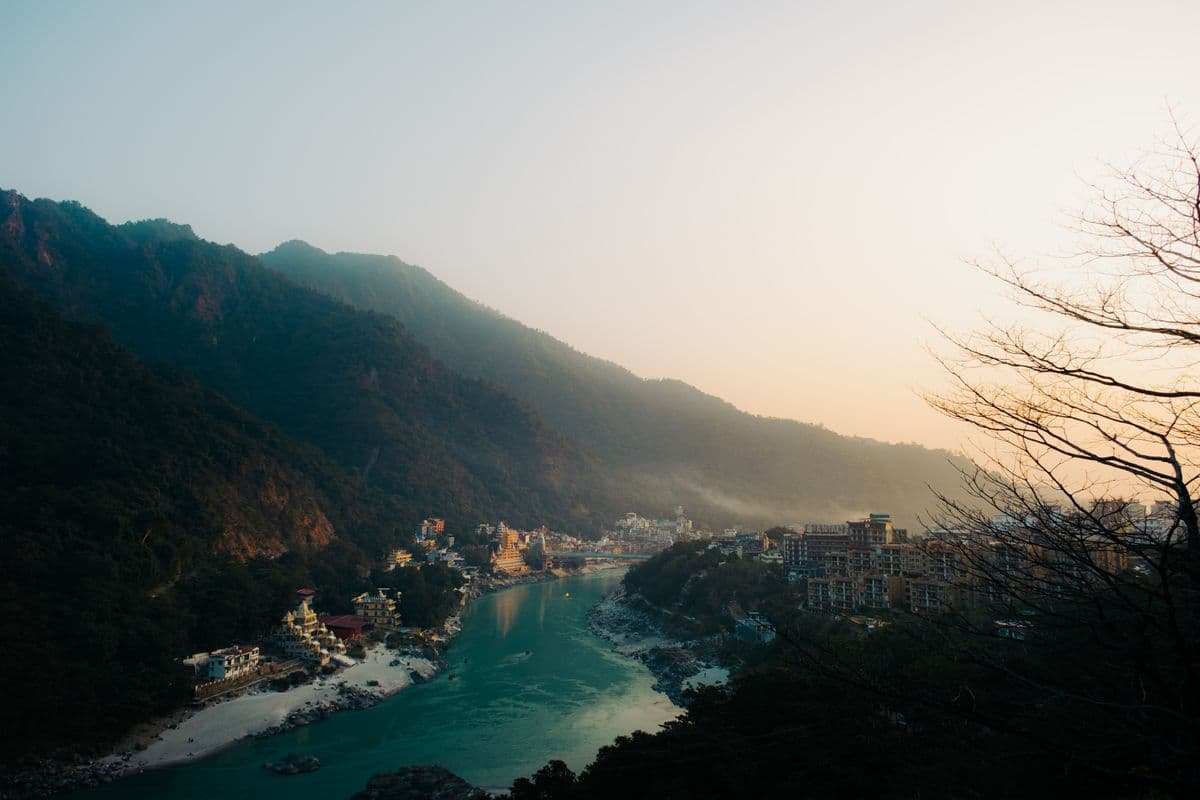
Neelkanth Mahadev is one of those places described as being just outside Rishikesh, which makes it sound far easier than it is. This is a mountain road trip, not a quick temple visit. You leave Rishikesh, climb into forested hills, follow a winding road through a completely different landscape, and arrive at one of the region’s most important Shiva temples. With half a day free, it is worth doing. With a few hours squeezed between fixed plans, leave it for another trip.
What Neelkanth Mahadev actually is
A Shiva temple in the hills above Rishikesh, associated with the story of Samudra Manthan, the churning of the cosmic ocean. In that tradition Shiva drank the poison that rose from the churning in order to protect the world, and his throat turned blue. Neelkanth means blue-throated. That story is why the temple matters.
The mountain setting is why the journey feels like a trip. You are not driving to another Rishikesh attraction. You are leaving the river valley and going into the hills.
How far is it, really
This is where travel sites become falsely precise. The distance depends on where in Rishikesh you start and which route you take, and the driving time depends on traffic, road conditions and the pace of a hill road. For planning, treat Neelkanth as roughly a half-day excursion: about an hour or more each way, with a proper buffer. Not something to add between lunch and the evening aarti.
Everything written about Neelkanth says “just outside Rishikesh”. That phrase is what makes people plan it badly.
The road is not boring
This is the reason to choose Neelkanth over ticking off another temple. The landscape changes as you leave town: the city thins out, the road winds through forested hills, buildings give way to green, and the temple appears at the end of a long mountain approach. If you enjoy road trips, that is half the attraction. If you dislike winding hill roads, this is useful to know before you commit a morning to it.
When to go
Morning is the easiest choice for most people: an earlier start, cooler roads, and room to absorb delays without worrying about coming back in the dark. Early also tends to feel calmer at the temple itself.
But do not pick a departure time because an itinerary says seven o’clock. Work backwards from your own day. If you have an evening aarti or anything else with a fixed time, leave room for the return. Mountain roads do not care about your timetable.
Before you go in
Neelkanth is an active place of worship, and that changes how to approach it. People come here to pray to Shiva, so do not treat it as a viewpoint with a shrine attached. Follow the temple’s instructions, be patient in a queue, and expect the atmosphere to change completely on busy religious days. It can be peaceful on one visit and packed on another.
Wear clothes that cover you properly and comfortable shoes for the drive and the walking. A layer if it is a cooler month. You do not need trekking gear for an ordinary visit.
And if you can, shower before you go. In Indian homes this is ordinary rather than formal: you bathe before visiting a temple. It is less about being clean than about arriving fresh, having set the morning aside for it. Nobody checks. But if you are wondering how to show respect somewhere whose customs are not your own, this is the thing that quietly counts.
Mahashivratri is a different day entirely
Around Mahashivratri, Neelkanth becomes a major pilgrimage destination and the numbers rise dramatically. If your purpose is pilgrimage, that can be the most meaningful time of all. If your purpose is a quiet mountain outing, it is the wrong day. Decide which visit you want before you choose the date.
Can you ride there on a scooter?
You will see people doing it. That does not mean everyone should. The route is winding hill road with real bends and changing surfaces. If you are not an experienced hill-road rider, take a taxi. The point of the trip is to reach the temple, not to prove you can handle every hairpin. And if the weather is poor, reconsider riding altogether.
What about the waterfalls?
The Neelkanth road also gives access to walks in the same hills, including Patna Waterfall. But do not assume you can add everything to one morning. Temple, waterfall walk, lunch and another stop looks efficient on paper and turns into a day spent getting in and out of a car. If you have the time, make it a long half day. If you do not, pick one main purpose and do it properly.
Neelkanth or Kunjapuri?
Two very different trips. Choose Kunjapuri for sunrise, Himalayan views, a hilltop temple and a shorter outing. Choose Neelkanth for a mountain road, a major Shiva temple, forested hills and a slower half day away from the river. You do not need both simply because both appear on somebody else’s itinerary.
Who it suits, and who should skip it
It is a good half day for:
- Anyone interested in Hindu temples, and Shiva devotees especially
- People who enjoy mountain drives
- Photographers, bloggers and content creators after forest and hill country rather than riverfront
- Repeat visitors who have already done Tapovan, the ghats and the bridges
- Anyone with half a day and a wish to leave the town behind
Skip it if your trip is short and already full. The temple matters, but the journey takes the time it takes, and a rushed Neelkanth is worse than no Neelkanth.
How it fits your days here
This one depends almost entirely on length. On a single day it does not fit, and trying is how people end up seeing nothing properly. Over two days it can work if it takes a whole morning and you accept that the afternoon is for resting. Over three it is comfortable, and you can pair it with the smaller temples on the way without rushing either.
How this works with us
Neelkanth is a half-day add-on to Live Like a Local and to the longer retreats. Your guide (host) arranges the car, leaves early enough that the road is quiet, and tells you honestly when the date you had in mind is a festival day and the temple will be shoulder to shoulder.
Frequently asked questions
How far is Neelkanth Mahadev Temple from Rishikesh?
The distance depends on where in Rishikesh you start and which route you take, and the driving time depends on traffic and road conditions. For planning, treat it as roughly a half-day excursion of about an hour or more each way, with a proper buffer, not something to squeeze between lunch and the evening aarti.
What is the best time to visit Neelkanth Mahadev Temple?
Morning is the easiest choice for most people: an earlier start, cooler roads and room to absorb delays without worrying about coming back in the dark. Early also tends to feel calmer at the temple itself.
Can you ride a scooter to Neelkanth Mahadev?
You will see people doing it, but the route is a winding hill road with real bends and changing surfaces. If you are not an experienced hill-road rider, take a taxi, and reconsider riding altogether if the weather is poor.
Should I visit Neelkanth around Mahashivratri?
Around Mahashivratri the temple becomes a major pilgrimage destination and the numbers rise dramatically. If your purpose is pilgrimage that can be the most meaningful time of all, but if you want a quiet mountain outing it is the wrong day.
What should I wear to Neelkanth Mahadev Temple?
It is an active place of worship, so wear clothes that cover you properly, along with comfortable shoes for the drive and the walking, and a layer if it is a cooler month. You do not need trekking gear for an ordinary visit.