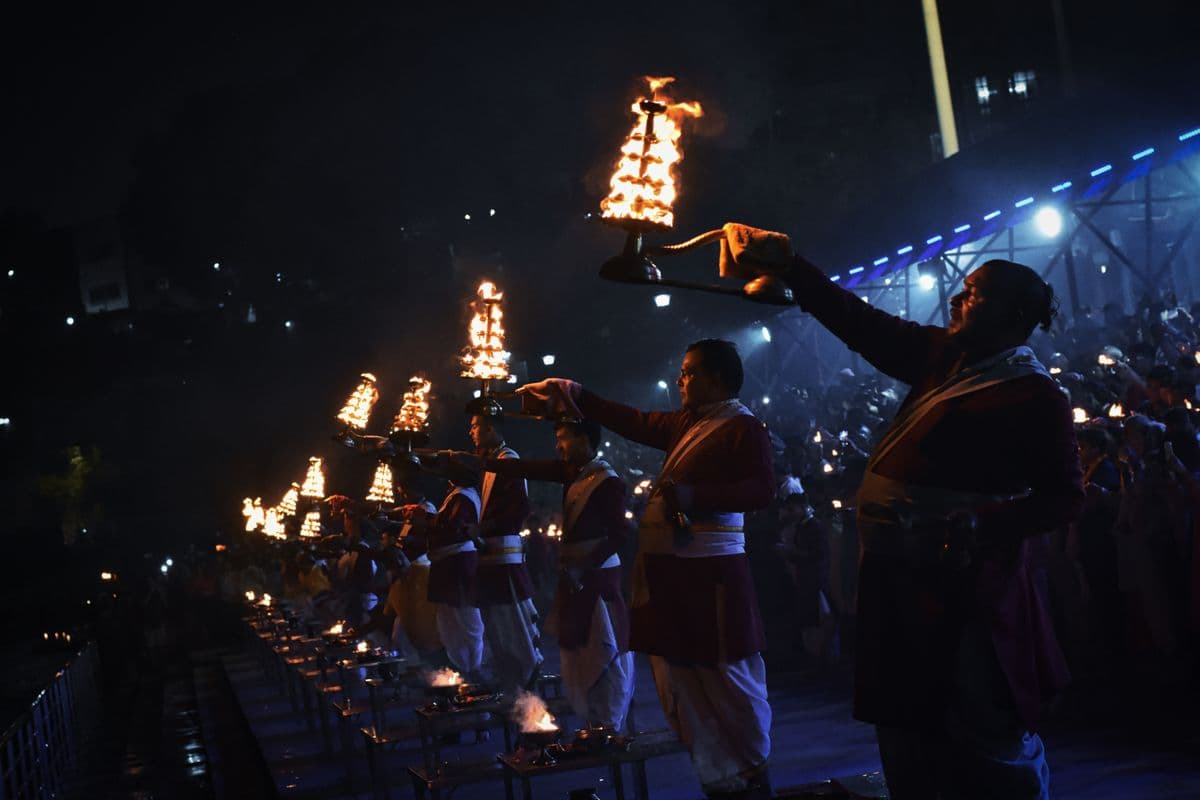
An Aarti is a ritual offering of light to the river: flames moved in circular motion, chanting, bells, incense. Rishikesh’s ghats hold both a morning and an evening version, and guests often assume they’re roughly the same ceremony at a different hour. They’re not, and picking the right one changes how the whole evening, or morning, feels.
The morning Aarti
Quieter, smaller, and considerably less crowded. It fits naturally into an early start: sunrise time, cooler air, a handful of other visitors rather than a packed ghat. If you’re already up for a dawn activity like Kunjapuri, it’s an easy, low-key addition on the way back.
The evening Aarti
This is the one people mean when they talk about “the Ganga Aarti” without qualifying it. As the sun sets, the ghat fills: priests in saffron robes lifting large, multi-tiered flame lamps in unison, the crowd joining the chanting, bells ringing continuously, and the whole riverbank lit by fire and diya lamps set adrift on the water. It’s louder, fuller, and considerably more atmospheric. Not every evening ceremony is that big one, though. The smaller ceremony at Sai Ghat runs the same idea at a fraction of the scale.
Morning Aarti is real and worth seeing if your schedule lines up. Evening Aarti is the one that becomes the story you tell when you’re home.
Why the evening version hits harder
It’s mostly about scale and light. The ceremony draws a larger crowd, more priests participate, and the fire is genuinely more dramatic against a dark sky than daylight. There’s also a sense of the whole ghat turning toward the same moment together (hundreds of people, one direction, one rhythm) that a quieter morning crowd doesn’t quite replicate.
Practical timing
Evening Aarti timing shifts slightly with sunset through the year, generally somewhere in the early evening window. Arriving even 20–30 minutes early matters if you want a clear view rather than watching over a row of heads; the ghat fills up fast in peak season.
How we time it for guests
We don’t just point you toward the ghat and leave the timing to chance. Your host builds the day so you arrive with enough buffer to actually get a good spot, not sprinting from your last activity and missing the start.