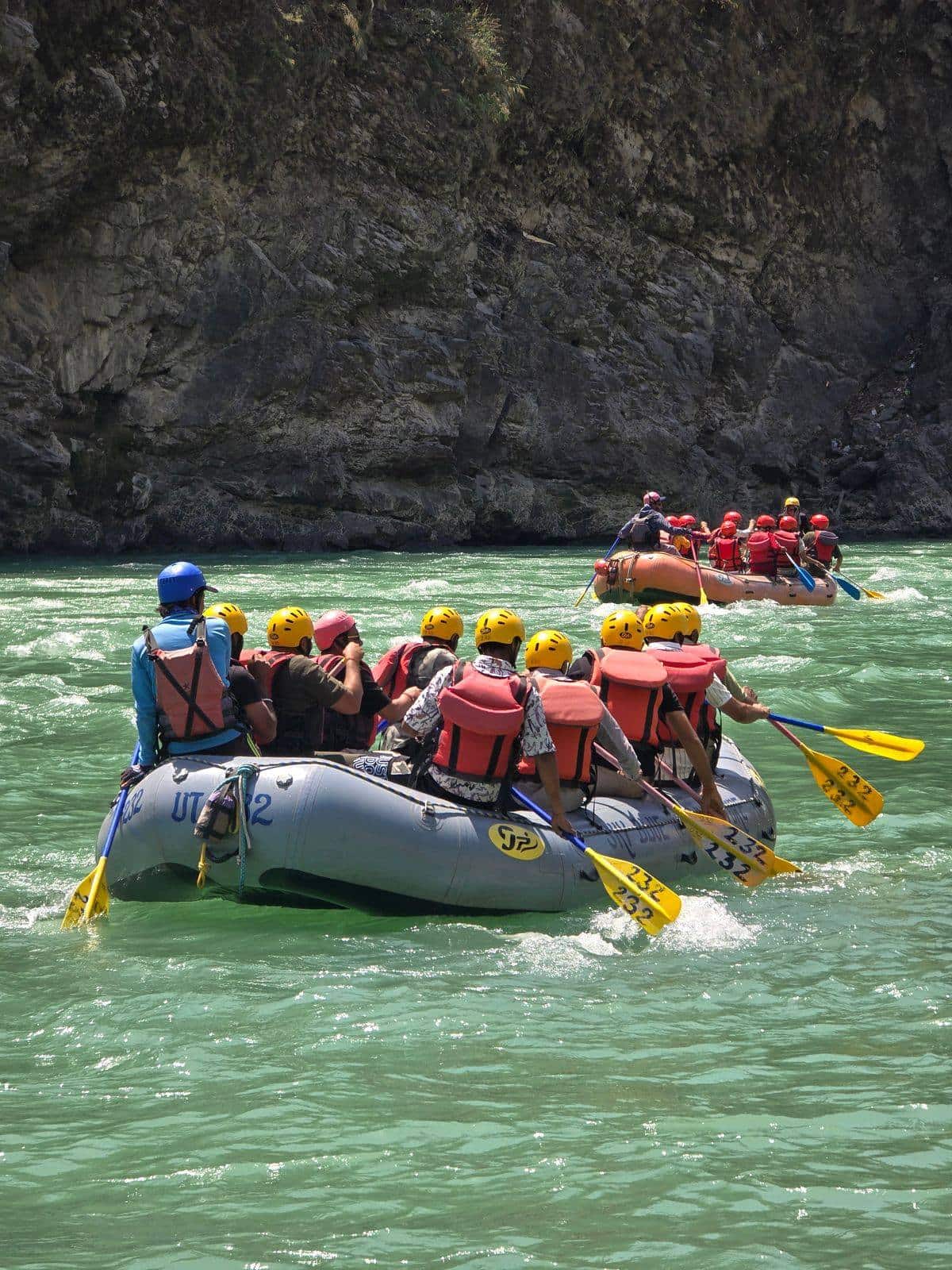
Most rafting listings say “thrilling white-water rafting on the Ganges” and leave it there. That’s not enough to actually decide what to book. The grade of the rapids changes who should be in the boat, how the two and a half hours will actually feel, and whether you’ll spend it grinning or gripping the safety rope the whole way down.
What the grades actually mean
Rafting difficulty is usually described on a I–VI scale, with I being flat water and VI being effectively unraftable. Rishikesh’s stretch of the Ganga runs mostly Grade II to Grade IV depending on where you start and how much water is coming down from the hills that season.
- Grade II–III: Clear, moderate waves. You’ll get wet, you’ll paddle hard through a few sections, but there’s no technical skill required and long calm stretches in between to actually look around.
- Grade IV: Longer, more powerful rapids with less recovery time between them. It demands more from your arms, your nerve, and your ability to follow instructions immediately when the guide calls them.
The four stretches, by distance
Nobody in Rishikesh sells you a grade. Every operator board on the Laxman Jhula road, every WhatsApp quote and every rate card prices the run by how far you float, and the distance is the decision. All four finish in the same place, under the town’s footbridges.
| Distance | Starts at | On the water | Who it suits |
|---|---|---|---|
| 9 km | Brahmapuri | About an hour | First time, children over the operator’s age limit, anyone unsure about the water |
| 16 km | Shivpuri | Two to two and a half hours | Most people. The one to book if you are only doing this once |
| 26 km | Marine Drive | Three hours or so | You have rafted before and want the bigger water without a whole day gone |
| 36 km | Kaudiyala | Most of a day, with the drive | Confident swimmers who want the hardest rapids on this river |
The grades follow the distance rather than the other way round. The 9 and 16 km runs sit in the Grade II–III range the whole way; the 26 and 36 km runs start further upstream and take you through the more technical Grade III–IV water before the river calms down through Shivpuri into town. Neither is “the real one”. They are different lengths of the same afternoon.
The three-day one, from Devprayag
There is a fourth thing nobody puts on a rate card, because it is not a day trip. Rafting expeditions run down from Devprayag, where the Bhagirathi and the Alaknanda meet and become the Ganga. They take two nights and three days to reach Rishikesh, camping on the sand between days on the water.
It is a different holiday from a two-hour raft. You sleep by the river, you eat by it, and you spend three days on water that most visitors see for one afternoon. It runs only in the settled season, in small numbers, and it needs arranging in advance rather than booking on the morning. Ask us and we will tell you honestly whether it is running and whether it suits you.
When the river is closed
Rafting on this stretch stops during the monsoon, broadly from late June until the water settles in September. That is not an operator being cautious; it is the river carrying too much silt and too much force to be safe, and it is enforced. If a trip is being offered to you in August, the honest answer is that it should not be.
The rest of the year, the water still moves. A stretch that is a comfortable Grade III in November can be a serious Grade IV in the weeks after the snow melt, which is why the same 16 km is a different afternoon in October and in May.
The right grade isn’t the one that sounds most exciting in a caption. It’s the one you’ll actually enjoy for the full two and a half hours you’re in the water.
Who should book which
Grade II–III genuinely suits first-time rafters, families with older kids, and anyone who wants the experience without the adrenaline being the entire point. Grade IV is worth it if you’re a confident swimmer, comfortable being thrown around a bit, and specifically want the harder version, not just because it’s the longer route on the price list. And if what you actually want is the adrenaline rather than the river, the bungee jump near Mohan Chatti answers that question more directly than any grade does.
The thing that matters more than the grade: season
Water levels shift through the year, and a stretch that’s a manageable Grade III in April can run noticeably higher after heavy rain upstream. Rafting is also paused entirely during peak monsoon months when the river simply isn’t safe to run. A good operator tells you the actual conditions the morning of, not the grade printed on a brochure six months ago.
What we actually do about it
We don’t hand you a stretch based on what’s easiest to book. Your host asks how you feel about being in open water, whether anyone in your group needs a gentler run, and what day you’re actually rafting, then matches you to an operator whose current safety checks and river read we already trust.