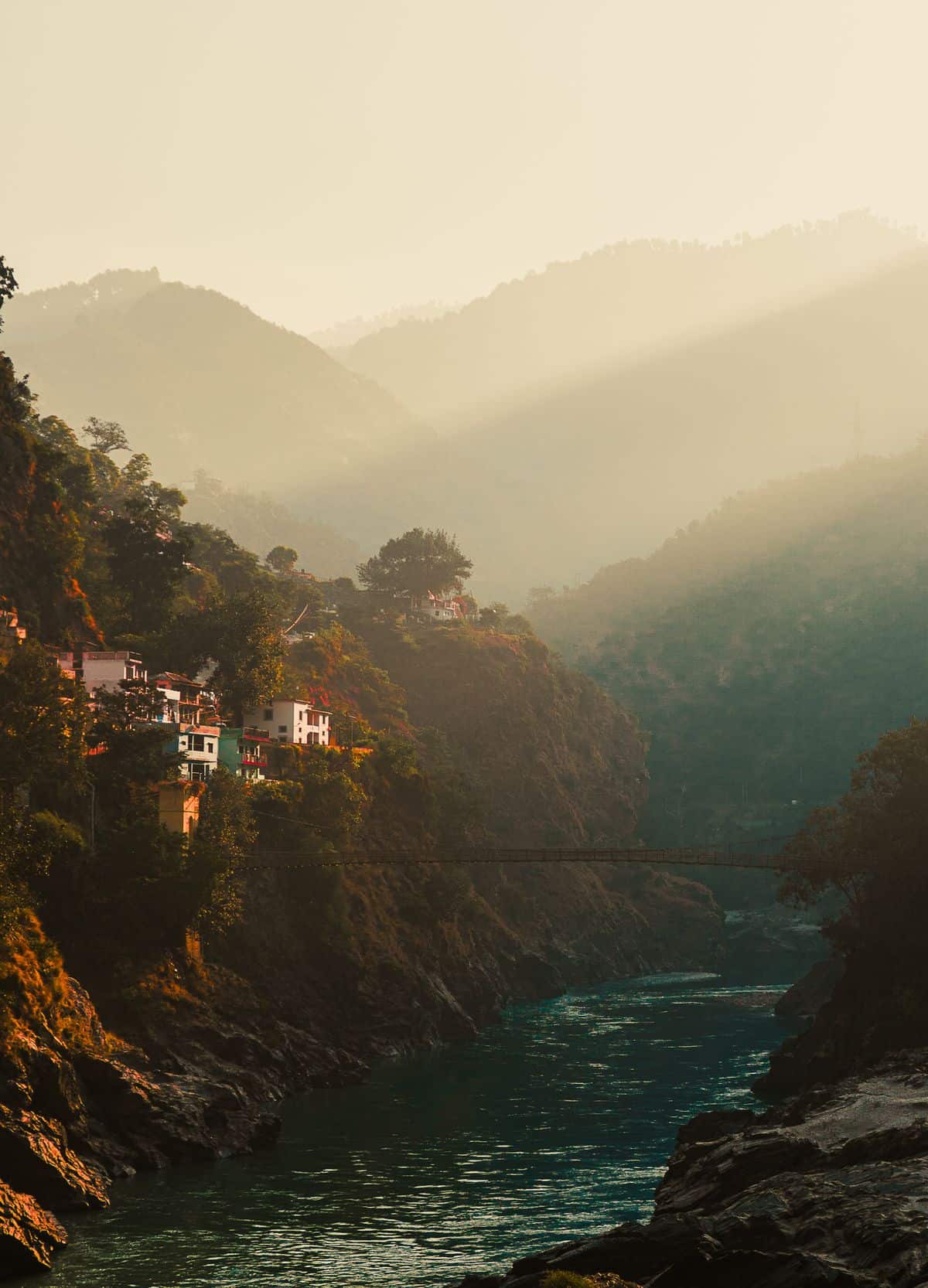
Rishikesh does not have one best place to stay. The right area depends on what you want your days to look like: cafés and yoga outside the door, or the river, or quiet mornings, or an ashram, or rafting. And underneath all of that sits a question the booking sites never raise, which is whether your taxi can reach the hotel at all. So this page does two neighbourhoods properly, the one your guide (host) lives in and the one at the bottom of his road, and is short and honest about everywhere else.
First, the question nobody answers: can a taxi reach the door?
Rishikesh above the bridges is built on a slope, on lanes that were not drawn for cars. Whether your driver stops outside reception or a few hundred metres below it, with your suitcase, is the single fact most likely to change which room you pick, and it is the one fact a listing page will never volunteer.
It matters more again with big bags, with small children, with older parents, on a late arrival, on a long stay, or in heavy rain. So do not ask how far the hotel is from Laxman Jhula. Ask whether a car can reach the entrance with your luggage. Here is our own shortlist, in the properties’ own words:
- The Hosteller, Upper Tapovan: a steep 450-metre walk, about fifteen minutes, up from wherever a car can drop you. There is no lift at the top of it either.
- The Hosteller, Laxman Jhula: there is a lift inside, but the roads right by the bridge are narrow and one-way, so a cab may not be able to reach the door at all.
- Aroma Ganga View: no lift (every room is reached by stairs) and no parking at the hotel. The nearest parking is about 100 metres away and paid.
- Arista Haven: a lift to every floor and free parking on site. If you are arriving heavy, arriving late, or travelling with someone who cannot do stairs, this is the easy answer.
- Both goSTOPS properties: on-site parking exists but is limited and not guaranteed, so tell us if you are driving yourself.
Past those we will not invent numbers, because inventing them is what makes hotel blogs useless. The one other walked figure we can stand behind is The Hosteller Ganges, two minutes from the bridge. Every other “five minutes from the bridge” you read, including on our own site, is a line on a map, and a map does not know about steps.
So ask before you book, not at the door. We ask on your behalf when you book through us, and we would rather move you to another property than watch you carry a bag up a hill you did not agree to.
Tapovan, including Upper Tapovan
Tapovan is the neighbourhood rising directly above Laxman Jhula, and it is where most of the yoga schools, guesthouses and long-stay travellers in Rishikesh actually live. It is also where your guide (host) lives, which is the only real reason this page can say anything useful at all.
It is a walking neighbourhood rather than a sightseeing one: cafés, laundry lines, yoga schedules on chalkboards, people who came for five days and stayed five weeks. You are above the river rather than on it, which means you get quiet and views and pay for both in stairs.
It is the easy place to start looking if:
- It is your first trip to Rishikesh
- Yoga is part of why you are coming
- You like cafés and casual restaurants and want to walk to them
- You are a blogger or a content creator and want the lanes, the cafés and the river all inside one morning
- You are staying several nights rather than one
- You want a base rather than a front-row seat
The trade is stairs. Upper Tapovan is the same neighbourhood, further up again along Balaknath Road: greener, calmer, further from everything, and everything is uphill on the way home. There is a free community kirtan up there on Wednesday and Saturday evenings that almost no visitor knows about, which tells you what kind of stretch it is. Do not book a room for its photographs. Ask about the final walk first.
What we can book you into here: Arista Haven (a lift, free parking, an indoor rooftop pool and a garden lawn: the softest landing on this list, and the hotel our retreats use), goSTOPS Tapovan PLUS (a rooftop pool, a café that runs 24 hours, and a 10 AM check-out that is genuinely not extendable), Holy Shivana (small, on the main road, a South Indian kitchen downstairs and a balcony over the street), The Hosteller Upper Tapovan (dorms including a women-only one, one private room, no alcohol, no under-18s even with a parent, hot water from 5 AM to 11 PM), and Aroma Ganga View on Laxman Jhula Road, whose rooms look out over the Ganga and whose stairs you should read about above before you fall for the view.
Laxman Jhula, if you would rather be in it
Down at the bridge the trade reverses. You are in it: the lanes, the cafés hanging over the water, the temple side across the river and the whole slow procession of pilgrims and backpackers, all outside your door rather than ten minutes below it. We have written the bridge up properly in the Laxman Jhula walking guide, so this is only about sleeping there.
One correction first, because it changes people’s plans and several pages online still get it wrong. Laxman Jhula is open. So is Ram Jhula. Both are walking only: no scooter, no motorbike. If you are on two wheels, you walk across and your scooter goes round by Janki Setu, which is the bridge built to carry them. Your guide (host) does exactly that most days. If you have read anywhere that Laxman Jhula is shut, that page is out of date.
Sleep down here if you want a lively street, if the Ganga is one of the main reasons you are coming, and if you have two or three nights and would rather not spend part of them walking down to the river and back up. Think twice if you need guaranteed car access, if you are arriving with heavy luggage, if you want a very quiet room, or if you are a light sleeper.
What we can book you into here: The Hosteller Laxman Jhula (a minute from the water, a lift, hot water around the clock, a vegetarian café, and those narrow one-way roads on the last stretch), The Hosteller Ganges (a stated two minutes from the bridge, with a rooftop café over the river; the boat from the Tapovan side lands in front of it), and goSTOPS Lakshman Jhula (a brisk walk, a 24-hour café, and a rooftop with the bridge itself in the frame).
There is no perfect answer here. You are choosing which inconvenience you would rather have.
The walk back after dark
We will not tell you a lane is safe on your behalf, because that is not a promise anyone can keep in writing. The climb is what actually shapes the evening. A 450-metre uphill walk that is fine with a coffee in the morning is a different thing at eleven at night with a phone torch, and if that sentence makes you uneasy, take it as a reason to pick a property a car reaches. Down at the bridge the walk home is short and busy for longer, which suits some people and keeps others awake.
For solo travellers, and solo women in particular: women-only dorms with lockers at The Hosteller Upper Tapovan, Laxman Jhula, Ganges and goSTOPS Tapovan PLUS. The Hosteller’s Upper Tapovan and Ganges let non-resident visitors in only between 9 AM and 9 PM, and goSTOPS keeps anyone who is not staying out of everything past reception. Quiet hours run from 10 PM to 8 AM at every hostel on our list. And if your train or flight lands at an hour that makes all of this feel like a bad idea, we plan around your real arrival time: check-in and sleep, with your guide (host) meeting you the next morning.
Food after nine, and how loud the room is
Late food is a building question, not an area one. Both goSTOPS properties run a café 24 hours, which is the most reliable late plate on this list. Arista Haven has its own multi-cuisine restaurant, Holy Shivana a South Indian kitchen downstairs, and Aroma its own café. The Hosteller cafés are self-service and pay as you go, two of them vegetarian, and they wind down at 10 PM. Our own market walk and dinner evenings are built to finish around nine, which tells you more about how late the lanes stay useful than any opening-hours list would. For where to actually eat, the six cafés locals actually love is the list we send guests.
Noise is a room-level fact, not an area-level one, so we will not publish a line like “the market is loud until midnight”. Holy Shivana’s balcony room looks straight out over the main road, and a room at the back of the same building is a different night’s sleep. Tell us you are a light sleeper and we will ask which way your room faces before you pay for it.
Monsoon moves the answer downhill
From July to mid-September the rain is heavy, the river is high, rafting usually pauses and the hill roads can slide. The best time to visit Rishikesh covers the season properly. For a room, it is the uphill lanes that change. Four hundred and fifty metres of climb is a different proposition in the wet, so for those weeks put practical access above a spectacular photograph, and the properties a car can reach move up our list. From late September into November, and again through the clear cold mornings of December to February, it flips back and the higher, quieter rooms are the better stay.
Where we would not book you, and why
Four areas we happily send people to and sell no rooms in. Short on purpose: we have no current first-hand knowledge of the rooms there and no inventory, and padding them out to look balanced would be the exact fakery this page exists to avoid.
Ram Jhula and Swarg Ashram. The car-free ashram side: the riverside walkway, the market lanes and the big evening ceremony at Parmarth Niketan on its doorstep. Uttarakhand Tourism describes Swargashram as a cluster of ashrams on the eastern bank of the Ganga, many of them running yoga and spiritual-study programmes, which tells you who it suits. If your trip is ashram life, meditation and the ghats rather than cafés, sleep on that side and walk to it, and know that much of it is pedestrian, so luggage often means walking. Our Ram Jhula guide is what to read next. We will plan your days over there. We will not pretend to know which of its guesthouses is any good.
Town, and Triveni Ghat. More practical, more connected, and a genuinely different Rishikesh from the one above the bridges. It is the right call if you are arriving by train or bus, if this is a short pilgrimage rather than a river-and-hills trip, or if Triveni Ghat and its evening aarti are the main event. It is right too if you have one night in Rishikesh and an early train out of it. We are not based in it.
Shivpuri. Upriver, and the base for the rafting camps. Uttarakhand Tourism lists it as a major rafting destination about 19 km from Rishikesh, and that distance is the whole trade: if the river is the entire reason you are coming, sleeping out there makes sense, and if it is not, the cafés, the ghats and the bridges all become a drive.
That is four areas talked out of six. We would rather lose the booking than have you land somewhere we cannot actually help you once you are standing in it.
So where would we stay, and the gap said out loud
For a first visit, Tapovan. Not because it is objectively the best part of Rishikesh, but because it balances cafés, yoga, a real choice of rooms, a walk down to the river and enough everyday convenience. If your trip has a clearer purpose than that, follow the purpose: ashram and meditation, cross the river; river days, sleep by the bridge; rafting, look upriver; short pilgrimage, town. And if you are arriving with heavy luggage or with family, forget the neighbourhood and pick the hotel a car can reach. That matters more than the view.
One last thing, because papering over it would be the wrong way to start. You came here for a room. We sell trips with a room inside them. Those are not the same thing.
So take the room first. Every property we book into is listed with its rooms, its real photographs and its awkward details, the no lift and the paid parking and the climb, written out rather than buried. If the days are still open too, the itinerary builder is where you shape those. Packages do not include a room: on the multi-day trips you book your own stay, and your host is glad to recommend places to suit your budget. And if you just want to know which of the nine suits you, ask. That answer is free and it takes one message.