Yes, for most travellers. But the useful answer is not a verdict. It is knowing what changes after dark, which annoyances are worth planning around, and what to ask before you pay a yoga school. We live and teach in Tapovan, so this is our own street rather than a summary of other people’s blogs.
Is Rishikesh safe for women?
Yes, for most people who come. But the risks travellers pack for are not the risks that catch them out. Rishikesh is a busy pilgrimage town and it behaves like one. Tapovan, Upper Tapovan and the lanes around Laxman Jhula are full of long-staying foreign students and people who have been practising here for months, and a woman walking alone in the early evening is unremarkable here in a way she would not be in most towns this size.
That does not mean nothing goes wrong. It means what goes wrong is mostly not what you are imagining. Almost everything we hear about is a twisted ankle on an unlit lane, a scooter slide, a monkey taking a bag, or a stretch of low-grade hassle from sellers. You can prepare for those. You cannot prepare for a verdict, so the rest of this page is physical detail.
Is Rishikesh safe at night? What actually changes
Nothing about the town turns hostile at nine o’clock. What changes is physical: fewer shops open, fewer people on some lanes, patchier lighting and thinner transport. A lane that felt busy in daylight is a different lane once the shutters come down, and that is worth describing properly rather than compressing into a warning to be careful.
The lanes, not the people. Street lighting above Tapovan is patchy and some road edges are uneven, with little between you and the drop on the river side. Shops shut one at a time, so the lane you walked up with the shutters open is not the lane you walk back down. The surface is the same. The light and the number of people are not. Carry a small torch, keep enough phone battery that the torch is still an option late on, and if a route feels quiet, take the longer busier one.
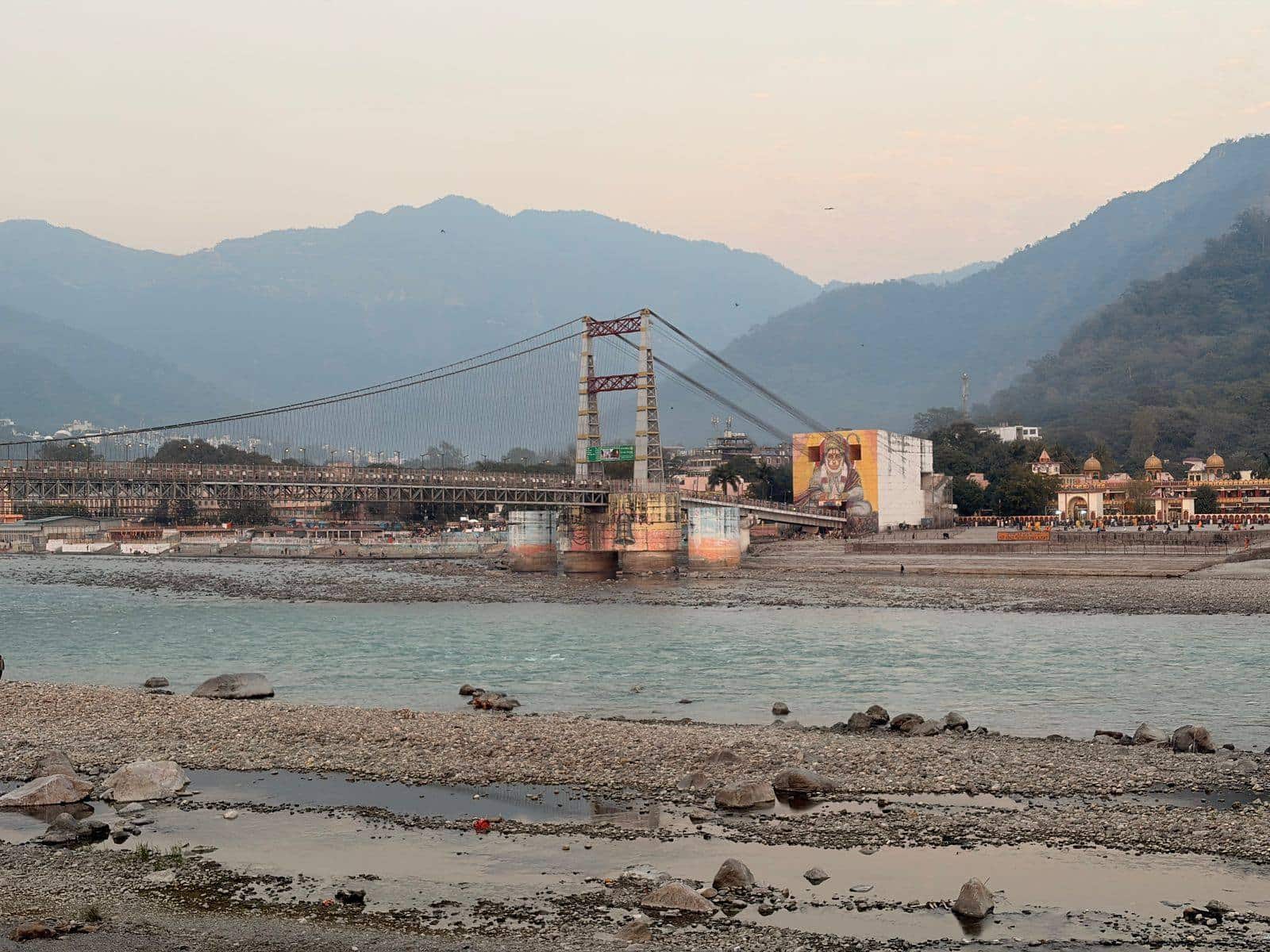
The bridges. Ram Jhula and Laxman Jhula are both open, and both are for walking only. No scooter, no motorbike. If you have rented one, you walk across and your scooter goes round by Janki Setu, the crossing that takes two-wheelers and the one with lamps down its whole deck. That is the bridge we point people at after dark. The two older ones are narrower and land you in market lanes that are lovely at six and considerably emptier once the shutters are down.
Dogs. The dogs that ignored you all afternoon are territorial at night, and they move in groups. Far more often a fright than an injury. Do not run, do not stop, do not make a fuss of them. Keep walking at the speed you already were.
Getting home. There is no useful last auto here and we will not invent an hour for you. Transport thins out rather than stopping to a timetable, and the higher up Tapovan you stay, the more that matters. Ask at your guesthouse desk in the afternoon how guests get back at night, and put a real driver’s number in your phone.
Scooters. Do not ride one at night in your first week. Learn the potholes, the blind corners, the traffic and the cows in daylight first. This is the single piece of advice here we would most like you to take.
The journey in. The drive up is the least safe part of the whole trip and nobody says so. Jolly Grant airport is roughly 21 to 22 km out, call it half an hour to forty-five minutes in a car. If you land after dark, keep the first evening simple: room, check in, eat, sleep, and start your Rishikesh in the morning. That costs you an evening, a real loss if you only have one day and barely registers over two or over three. If the timetable lets you choose, arrive in daylight.
Almost nothing we hear about here is an assault. It is an ankle, a scooter, a monkey, or a week of being sold things.
The parts nobody puts on a safety page
A page telling you everything is perfect deserves to lose to a real traveller’s blog, so here are the genuine annoyances.
The Laxman Jhula hustle. On the approaches to the bridge someone will fall into step with you and be, within thirty seconds, your guide. Or your astrologer. Or the man who can arrange your rafting, your taxi and your yoga course. None of it is dangerous and most of it is not even dishonest. It is simply relentless. A pleasant “no, thank you” said once and then not said again is enough. You do not owe a stranger a conversation, and a conversation is exactly what is being asked for.
Staring and photographs. This is real and we will not pretend otherwise. It is worst at weekends and in the pilgrimage months, when domestic tour groups arrive, and it is looking rather than following. You may be asked for a photograph, or find one being taken without anyone asking. “No” is a complete sentence here and nobody will make a scene. It is not danger. It is tiring, and being told in advance beats being told it does not happen. Two things help: shoulders and legs covered at the ghats and inside any temple, which is ordinary here rather than formal, and stepping into a shop or towards a busier place the moment someone makes you uncomfortable. You do not have to stay polite at the cost of your own comfort.
Monkeys. The most common cause of a ruined afternoon here, by a distance. Do not carry food openly, do not dangle a plastic bag near the bridges, do not feed or tease them, and do not make eye contact.
The river. The Ganga here is cold and powerful even where the surface looks calm, and in monsoon it runs heavy and brown and loud. Rafting stops entirely in peak monsoon because the river is not safe to run, which tells you what it is doing to the ghat steps you sat on in March. Do not go into moving water because other people are. Our guide to the rapids makes the one point that matters if you ever do: never try to stand up. If you are choosing dates around this, the season guide is honest about monsoon.
The one thing worth genuinely watching for
If a teacher, school or healing centre starts pushing unsolicited one-to-one sessions on you in your first days, especially private hands-on work or a meeting somewhere isolated, you are allowed to leave. That is the only item here we would call a risk rather than an annoyance.
A serious school has named staff, a fixed timetable, and no interest in isolating a student. Before you pay, ask who your teacher will be for your dates, what a day looks like hour by hour, how private sessions are handled, and who you speak to if you have a concern. Then look that teacher’s name up on its own. A reputable school finds all four easy. The longer version is in how to choose a yoga school here without regret. Choose the school carefully and a surprising amount of the rest looks after itself.
Where should a solo woman stay in Rishikesh?
Choose the area as carefully as the room. Tapovan, Upper Tapovan and the lanes around Laxman Jhula are the stretch of town where a woman on her own is ordinary rather than notable, and where there are other travellers on the same lane at the same hours as you.
Several of the hostels we work with keep a women-only dorm with its own lock-up. That is not something we arranged; it is how the better hostels here are set up. You can see which ones on our stays page, and the neighbourhoods compared in our guide to where to stay.
What matters more than the room is the last two hundred metres. A property can sit beside a road on a map and still mean a steep, dark walk with luggage. Ask this before you book, of us or of anyone else:
- How far is the door from where a car can actually stop? It varies enormously and is rarely on a listing. One hostel we use sits at the top of a steep 450-metre walk from the nearest drop-off, about fifteen minutes. Pleasant with a coffee, and a different walk at eleven at night with a rucksack.
- Can a taxi reach the entrance? By Laxman Jhula the roads are narrow and one-way, so for some properties the answer is honestly no. Better to know that before you are standing in the lane deciding.
- Where should I be dropped after dark, and is that route lit? Often the sensible answer is a different corner from the daytime one.
- Stairs or a lift? Some buildings have no lift at all. Worth knowing with luggage, and worth knowing if you are ill.
- What does check-in need? A government photo ID, plus passport and visa copies if you are a foreign guest. Quiet hours at several of the hostels run 10 PM to 8 AM, which is a genuine part of why those buildings are calm at night.
Then walk that route once in daylight on your first day. Five minutes, and it removes almost every unpleasant version of arriving home late.
Numbers worth putting in your phone before you land
Save these now. Searching for a number is the one thing nobody does well in the moment they need it.
- 112 is the national emergency number, anywhere in India. Police, fire and ambulance on one number, from any phone.
- 1090 is the women’s helpline for Uttarakhand, listed by Uttarakhand Police on their own contact page.
- 1364 is Uttarakhand’s tourism helpline, 7 AM to 9 PM. Useful for a stuck-traveller problem, but not an emergency line and not open at the hours this page is about.
Re-check all three when you plan the trip, because official contact arrangements do change. And a four-digit helpline is harder work in a second language than a person who knows which lane you are on. Keep a local number too.
What we actually do, and what we don’t
This is the only trust claim we fully control, so it is the only one we make. You know who you are meeting before you land: one named host, with their photograph and their number, on WhatsApp for the whole trip. Not a call centre queue, and not an unknown guide assigned on the day. Anyone brought in for a rafting crew or a trek is checked for safety practice first.
And against our own interest, since this is what we sell: you almost certainly do not need to pay anybody to look after you here. At a decent school in Tapovan for a month, a local minder is unnecessary and we will say so. It earns its money in narrow cases: a 2 AM arrival, a monsoon road closure, falling ill mid-course.
If you are still deciding
Most women reading this are asking something broader than what to book. They are asking whether they will feel comfortable here alone. For most the answer is yes, and the ones who find it easiest are usually:
- First-time solo travellers who want a town small enough to learn in a week
- Yoga students on a course, who arrive with a timetable and a group already
- Bloggers and content creators travelling alone with a camera
- Anyone who would rather be up at six than out at midnight
The useful next step is not a package. Work out how many days you actually want, then build the trip yourself in the itinerary builder and you will see what the days look like, which answers “will I be alright here” better than any reassurance on a website. Come with normal travel awareness, choose the address as carefully as the room, and trust your instincts when something feels wrong. If one specific worry is holding you up, ask it directly. There are more plain answers on our FAQs.