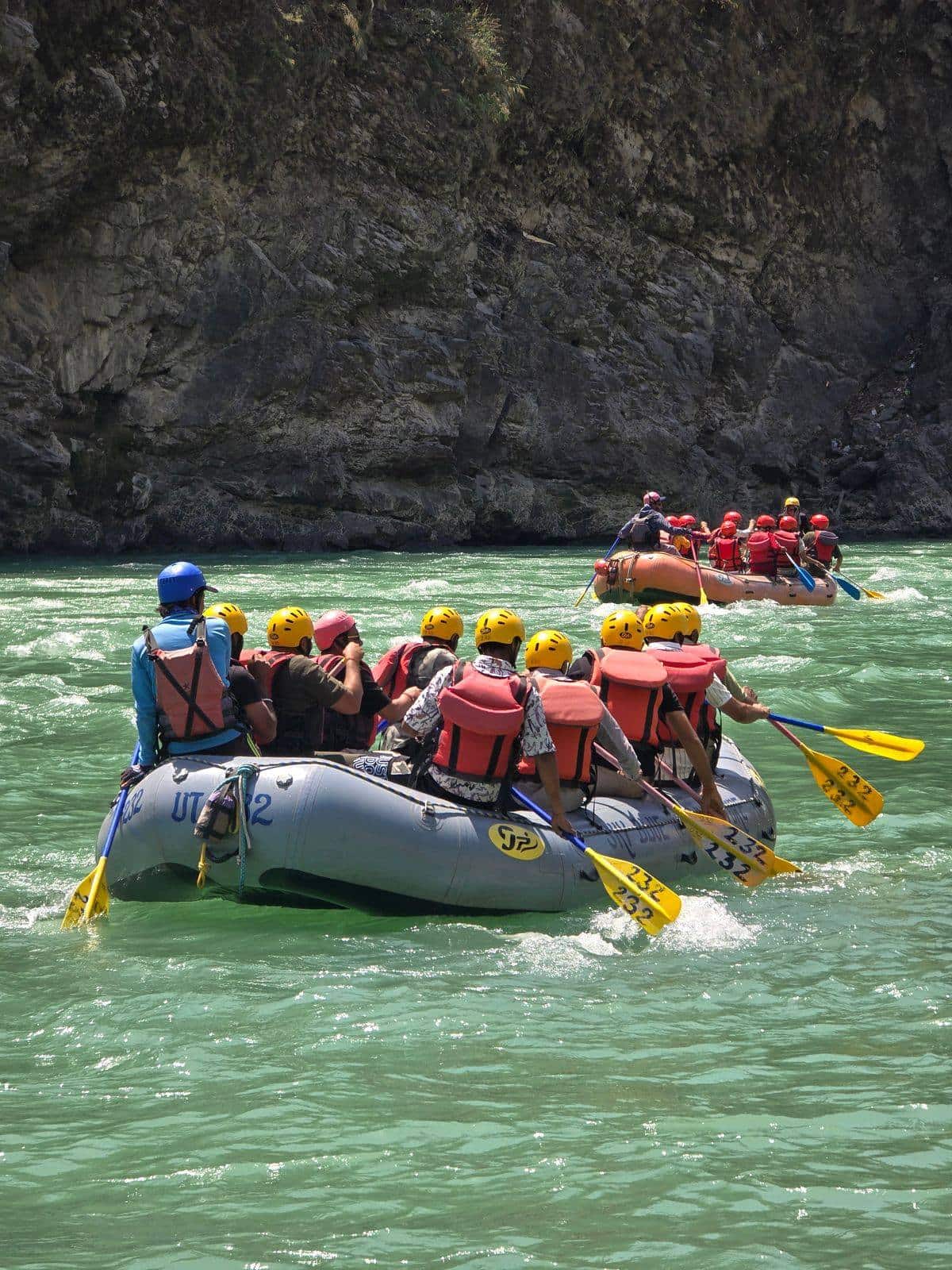
Almost everybody who rafts in Rishikesh does the same thing. Drive upstream, get in a raft, spend a couple of hours on the Ganga, get out, have lunch, go back to the hotel. There is another way to do it, and it never appears on a rate card because it is not a day trip at all: seventy kilometres of the Ganga, from Devprayag down to Rishikesh, over three days, camping beside the water instead of returning to town every evening. You are no longer fitting rafting into a Rishikesh holiday. For three days, the river is the holiday.
Why you start at Devprayag
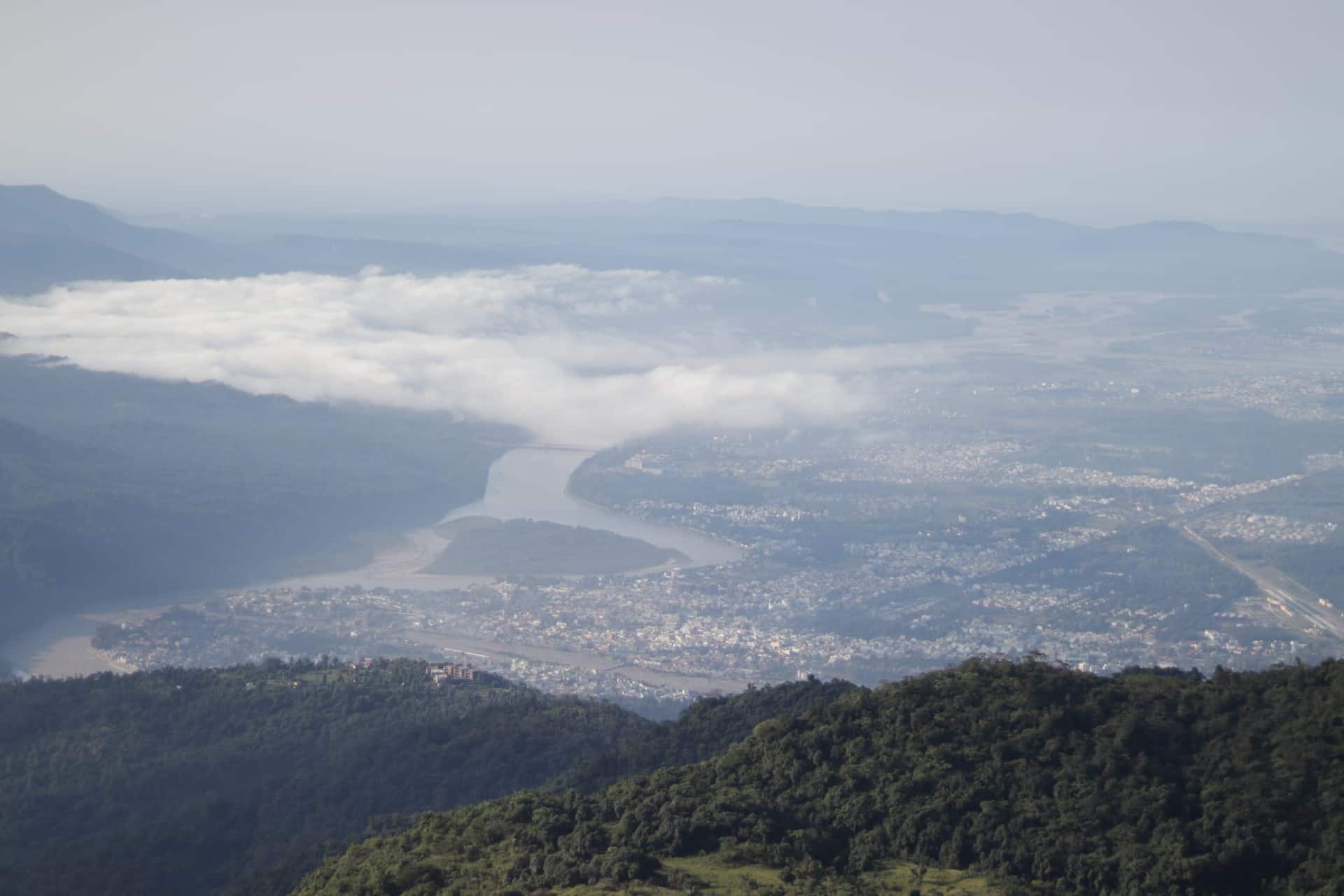
Devprayag is one of Uttarakhand’s Panch Prayags, the five sacred confluences, and it is where the Bhagirathi coming down from Gangotri meets the Alaknanda. Below that meeting point the river is known as the Ganga for the first time. So the put-in is more than a convenient place to launch a raft. Everything you have read about Rishikesh, the aarti, the ghats, the bridges, sits seventy kilometres downstream of where your first morning begins.
If the name already sounds familiar, it is probably from the other reason people drive up there: India’s highest bungee, 219 metres over the same gorge. Same village, completely different day.
This is not just a longer rafting trip
It is tempting to read three days as more kilometres and more rapids. That is not really it. A normal trip gives you a few hours on the river. An expedition changes where you sleep, how you travel and how you take in the landscape.
You wake up beside the river. You pack up beside the river. You raft through the day. You stop somewhere in the valley, eat dinner beside the water, and sleep there. The next morning you do it again. That rhythm is the expedition, not the distance.
The three days
The exact itinerary moves with the operator, the river conditions, the camps and the permissions, so do not read this as a fixed schedule. The basic shape is straightforward.
Twenty-odd named rapids across the three days, from playful Grade II up to Grade IV. If those names mean nothing to you, the guide to the four day-stretches explains what a grade actually feels like from inside a raft.
That final day is the section most visitors know. For somebody on a normal rafting trip, those 16 km are the entire adventure. For you they are the last morning, and the river hands you back to roads and ghats gradually rather than all at once.
The camping is not an add-on
This is probably the biggest difference between an expedition and a normal rafting package. People book it for the rapids and talk afterwards about the evenings. A tent on the sand at the river’s edge. Dinner after a full day outside. No café to walk to, no traffic outside the hotel, no plan for the evening. Just the river, the gorge, and the people you spent the day paddling with.
Darkness arrives differently in a river valley, and so does morning. It gets genuinely cold by the water even in warm months, and the sound does not stop all night. None of that can be reproduced by booking a longer commercial session.
Two hours on the river is an activity. Three days beside it is a trip.
How difficult is it?
This is where you have to be honest with yourself. The expedition includes easier water, but it also reaches the hardest sections above Rishikesh, and Uttarakhand Tourism says plainly that the challenging Kaudiyala section should not be attempted without an expert guide. So it is not our recommendation for somebody who has never been in a raft before. If you are completely new to white water, do the standard 16 km from Shivpuri first. It is the same water you would run on your final morning, and one afternoon on the river will tell you far more about whether you want three days of it than any article can.
You do not have to be a professional rafter, though. There is a difference between being experienced and being professional. Nobody needs years of competitive paddling behind them. You do need to be comfortable in moving water, physically able to take part all day, and prepared to follow your guide without hesitating. The harder sections are exactly where teamwork matters. The raft does not care who the strongest person in the group is. It cares whether everybody paddles together.
There is no convenient exit halfway
A two-hour trip can finish and have you back in Rishikesh for lunch. An expedition takes you into the river valley for days, and once you are downstream the road is not sitting beside you at every bend. That is part of the adventure. It is also why you choose the operator carefully, confirm the itinerary before departure, and mention any physical limitation or concern in advance rather than at the put-in.
Skip it altogether if you have heart, blood pressure, asthma or epilepsy concerns, or if you are pregnant. Operators also set age limits for the expedition that are stricter than for a day trip, and some set an upper limit as well as a lower one, so get those confirmed before you build three days around it.
When does the expedition run?
This is a seasonal adventure. Uttarakhand Tourism currently gives September to June as the rafting season in the state. The monsoon is a completely different proposition: high water, rainfall and mountain road conditions affect both the rafting and your access to the river. So do not assume that because a page advertises a three-day expedition, the expedition is available on every date. Pick your travel window and ask before you plan around it. This one also cannot be booked on the morning, the way a two-hour raft can: small numbers, specific dates, permits and camps that have to be held.
Especially at the beginning or the end of the season, confirm:
- Whether the expedition is running at all
- Which stretch is operating
- What the river is doing right now
- Where the camps are
- How many hours a day you will be on the water
- What equipment is supplied, and what you carry yourself
What should you take?
Pack lighter than you think. You are not checking into a hotel every evening.
- Quick-dry clothes and swimwear
- A warm layer for the evenings
- Secure sandals or suitable river footwear
- Sunscreen, a small towel, personal medication
- A headlamp
- A reusable water bottle
- A dry bag for anything you absolutely cannot afford to get wet
Leave the suitcase behind. The river does not need it.
Who it suits, and who should skip it
Do it if:
- You have already rafted and want something bigger than a day trip
- You like camping and being outdoors
- You want the river to be the main experience, not one line on a list
- You shoot. Photographers, bloggers and content creators get the gorge at first light from a sandbank, which is not a morning anybody driving up for an afternoon will ever see
- You enjoy remote landscapes more than comfortable hotels
- You are happy giving up phone signal and normal conveniences for a few days
Skip it if:
- This is your first time rafting
- You mainly want to see Rishikesh itself
- You do not like camping
- You need reliable road access throughout the day
- You want a flexible sightseeing schedule
And then there is length, which is the honest one. Three days on the river are three days not spent in Rishikesh. On a single day here it is not a choice at all, and over two it swallows everything else you came for. It starts to make sense when you have a week, or when you would genuinely rather give the water your whole three days than spend them the usual way. There is absolutely nothing wrong with booking the 9 km or 16 km trip instead. The expedition is not the better version. It is a completely different experience.
The simple version
Two or three hours of adrenaline: book normal Rishikesh rafting. A longer river day: choose a longer upstream stretch. But if what you actually want is to disappear into the Himalayan river valley for a few days, sleep beside the Ganga and arrive by water on the final morning, this is the trip. You did not just go rafting here. You followed the Ganga into town.
How we handle it
This is not inside any of our trips and we are not going to pretend otherwise. It is arranged on request: tell us your dates, and we come back with whether it is running, which operator we would put you with and what it costs, before you owe anything. If the water or the season is wrong for the days you have, we say so instead of taking the booking.