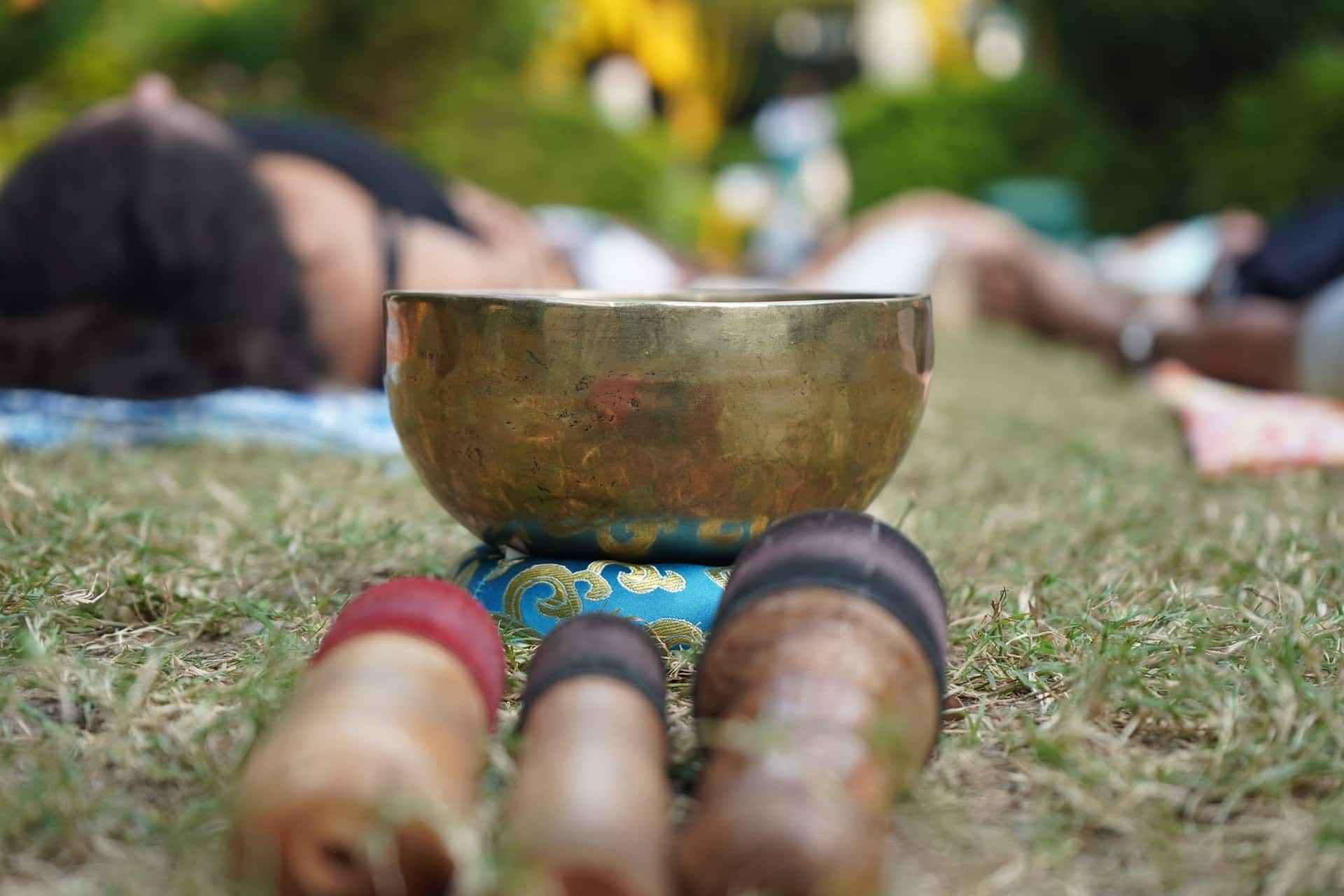
You lie down on a mat. Someone puts a blanket over you. Then a person you met on the way in starts hitting metal bowls. That is the whole description, and it is why sound healing in Rishikesh is one of the few things on a schedule that almost nobody arrives curious about — and one of the few people still bring up on the last morning.
What actually happens in a session
There is nothing to learn and no way to do it badly. Shoes off at the door. You get a mat, usually a bolster for under the knees, and a blanket, because the body cools down quickly once it stops moving. You lie on your back and close your eyes. The facilitator sits at one end with the bowls arranged around them, often a gong on a stand behind.
It starts sparse. One bowl, struck once, then a long gap while the tone runs itself out. Others come in slowly. Sometimes a bowl is carried around the room so the sound reaches you from a different direction; sometimes one is set on the floor near your head, or on the body if you agreed to that beforehand. The gong comes later and is the loudest thing that will happen — it builds rather than bangs, more like weather arriving than a drum.
Then it thins out and stops, and the room stays quiet for a while before anyone speaks. That silence is part of it, not the end of it. Session lengths vary from facilitator to facilitator, so check the day plan rather than assuming, and try not to schedule anything tight straight afterwards. Halls here are rarely soundproofed, which turns out not to matter at all — the Ganga is somewhere in the background, along with a bell, a scooter, a bird.
Nothing needs preparing. Wear something you can lie down in comfortably and bring a layer, because the room will feel cooler than you expect once you stop moving. Socks help. A heavy meal just beforehand does not. Arriving a little early matters more than people think: settling in slowly is easier than walking in flustered and trying to catch up with a room that has already gone quiet.
The instruments, in plain terms
Knowing what is making each noise makes the whole thing easier to settle into.
- Singing bowls: Metal bowls, struck with a padded mallet or circled around the rim. Sold as Tibetan or Himalayan bowls, and stacked in the shops near Laxman Jhula. A good one holds its tone far longer than you expect.
- The gong: The big one. Played up from almost nothing to a wall of sound and back down again. This is the part people either sink into or brace against.
- Tingsha and chimes: Small cymbals and bells, mostly used to mark edges — the beginning, the end, a change of direction.
- Voice: Some facilitators chant or hum through parts of it. Others say nothing at all from start to finish. Both are normal.
What people typically report feeling
These are things guests say afterwards, not effects anyone can promise you. The honest version is more interesting than the sales version anyway.
The one we hear most is weight. People describe the body going heavy and the floor feeling closer than it did when they lay down. Another common one is losing the thread of time altogether — you are fairly sure only a little of it has passed, and far more has.
Plenty of people drift in and out of sleep without going fully under. Some fall properly asleep and wake up mildly embarrassed. Nobody minds; the facilitator has seen it happen many times before. Occasionally someone finds it emotional and quietly cries, which is also ordinary. And some people feel pleasant and unremarkable and nothing more — a normal outcome that never makes it into a brochure.
Who it suits, and who should speak up first
It suits people who cannot meditate. That is the strongest case for it. Nothing is being asked of your concentration, so the usual failure — sitting there irritated with yourself for thinking — has nowhere to happen.
It suits the over-tired. Plenty of people book sound healing in Rishikesh after a long travel day, a morning on the Ganga, or a drive into the Himalayan foothills — and lying flat on your back beats another coffee. It suits sceptics too, because there is nothing you have to believe for it to work as rest.
It suits you less well if lying still for a long stretch genuinely feels like punishment. A few things are worth saying before you lie down rather than after: if loud low frequencies bother you, if sound sets off migraines for you, if you have a hearing condition, or if you would rather not have a bowl placed on your body. A good facilitator will leave the gong out, seat you further from it, or leave the door open so you can step outside without it becoming a scene.
Being honest about what it does
You will find claims online about specific frequencies, cell repair and brainwave states. Ignore them. What can be said fairly is narrower and still worth something: guests commonly describe deep rest, a head that stays quieter through the evening, and an easier night’s sleep afterwards. Those are descriptions of an experience, not results anyone can promise you. Sound healing is not a treatment for any medical condition and is no substitute for care from a doctor. If you are managing something health-related, talk to your own clinician rather than to a facilitator.
Many yoga schools and retreats around Rishikesh now offer it in some form, and the good ones describe it roughly the way we just have. Take it as a stretch of enforced stillness with something to listen to and it delivers, reliably. Take it as medicine and it will let you down.
Nothing is asked of you. You lie down, and the room does the rest.
How this fits into a trip with us
A Sound Healing session is built into the Rebirth Wellness Retreat, so it is already on the schedule there — placed in the afternoon, once the moving around is done for the day. The day plan on that page shows where it sits.
If you are on Reset or Restore, on one of our shorter packages, or not on a retreat at all, it can be added on. There is a group session and a private one-on-one, and your host will tell you plainly which suits the week you are actually having. Say so early if you want the private version, since that depends on the facilitator being free.